Settings
Profile, My View, aircraft, group, club rules and Member Experience, billing rates, fixed expenses, sales tax authorities, Stripe Connect, members and Message Members, ledger setup, and subscription — the full Settings page on the web dashboard.
Overview
The Settings page on the web dashboard is where Owners and Admins configure everything about the group, and where every member maintains their own profile. It mirrors the mobile Settings screen for personal/profile fields but adds the administrative editors that are view-only on mobile — sales tax authorities, Stripe Connect onboarding, payment configuration, and member ledger setup — and consolidates Members management as a tab here rather than as a separate sidebar item.
The page is organized into six tabs across the top, each shown only to the roles that need it:
| Tab | Visible to |
|---|---|
| My Profile | Everyone |
| Aircraft & Group | Owners, Admins |
| Billing | Owners, Admins |
| Members | Owners, Admins |
| Ledger Setup | Owners, Admins |
| Subscription | Owners |
If you’re a regular member you’ll only see My Profile. Mechanics see no Settings page at all — their access is restricted to maintenance, squawks, and documents.
My Profile
The personal-info tab that every account has access to — your own profile only.
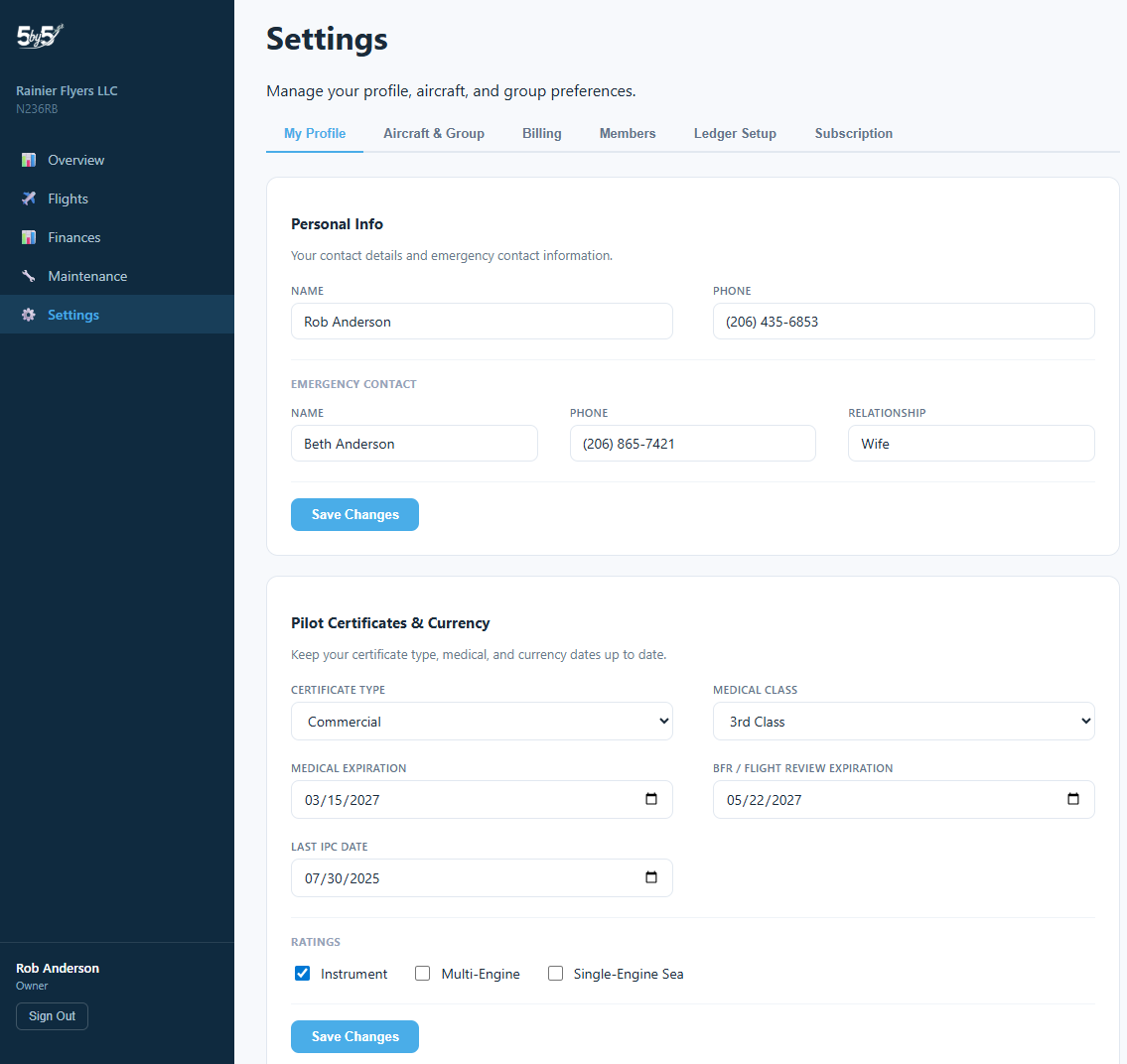
Personal Info — name, phone, email, emergency contact name/phone, and emergency contact relationship. These match the mobile Settings; editing in one place is reflected everywhere.
My Aircraft Photo — single-aircraft groups only: your own picture of the aircraft, shown at the top of your home screen in place of the one the admin set. Only you see it. Revert to the group photo removes it and puts the shared picture back. Groups with more than one aircraft don’t have this — there, each airframe’s photo on the Fleet page is what everyone sees.
Pilot Credentials & Currency — pilot certificate type, ratings (single-engine, multi-engine, instrument), medical class, medical expiration, flight review date, and last IPC. The values here feed the Pilot Currency tracker shown on every device.
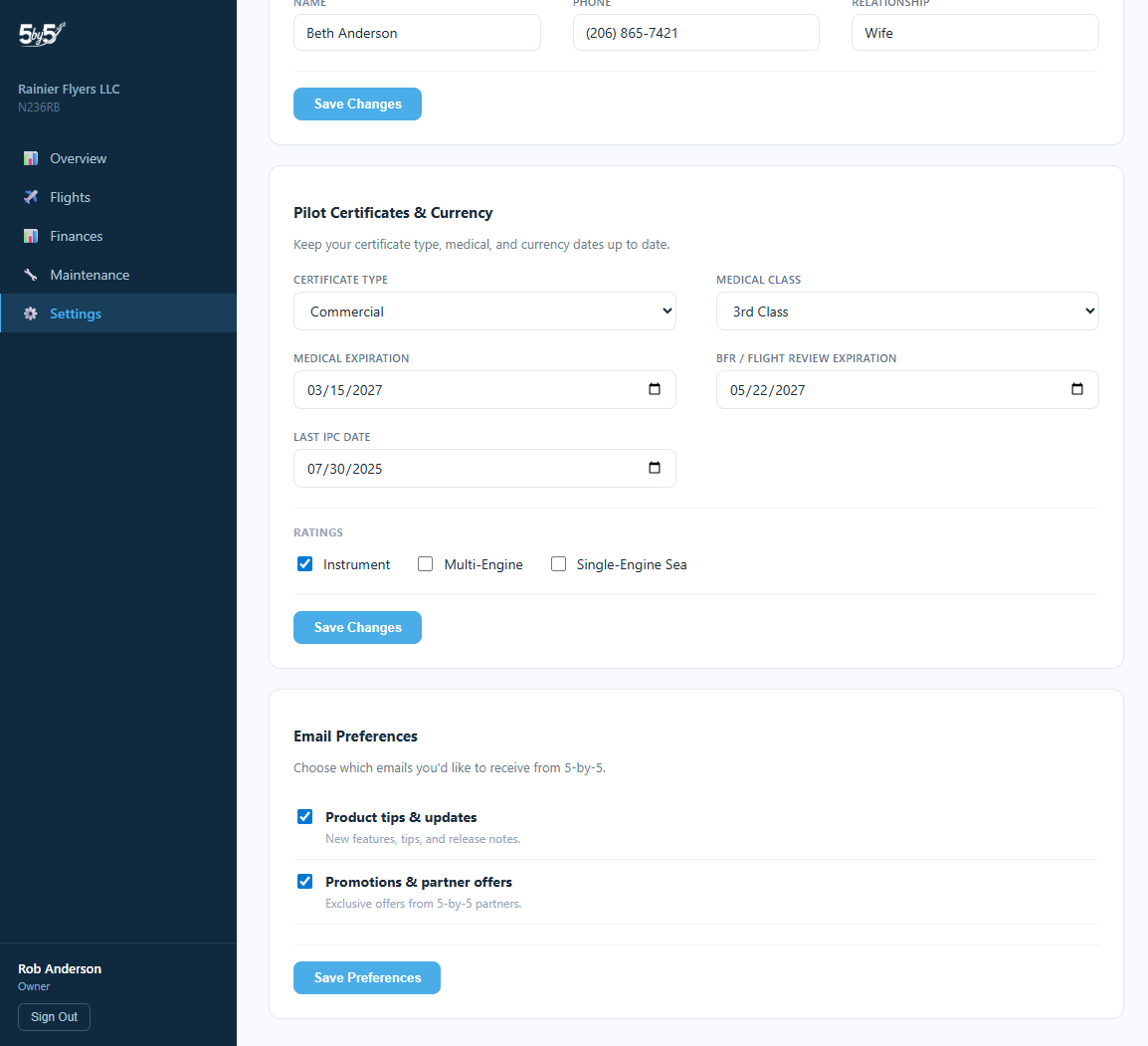
Email Preferences — pick which email categories you want to receive from 5-by-5. See Email Notifications for the full list of categories.
My View (club members) — your own version of the club’s Member Experience settings. See My View below.
Authentication — change the email address or password used to sign in to 5-by-5. Email changes send a confirmation link to both your old and new addresses (you must click the link in the new address to complete the change). Password changes take effect immediately on the device you’re using. The same card shows your two-factor status and how many recovery codes you have left, with a button to generate a fresh set. They are displayed once and cannot be shown again, so copy them before you leave the page. See Account Security for the whole picture.
Member Security (Members tab, owners and admins) — one switch: require two-factor authentication for every member of the group. Off by default.
Personal Data Rights — two actions that satisfy the access and erasure principles under EU GDPR, California CCPA, and Australian Privacy Act §7.3:
- Download My Data — exports a JSON file containing your profile, flights, ledger entries, bookings, and currency records. Same export the mobile app produces; just delivered through the browser.
- Delete My Account — permanently removes your profile and authentication record. Group history (flights, ledger entries) remains in the group but your name is anonymized. If you own a group with other members, transfer ownership first or deletion will fail.
Aircraft & Group
Owners and Admins use this tab to set up the aircraft and the group itself. Members see the values these admins entered but can’t change them here.
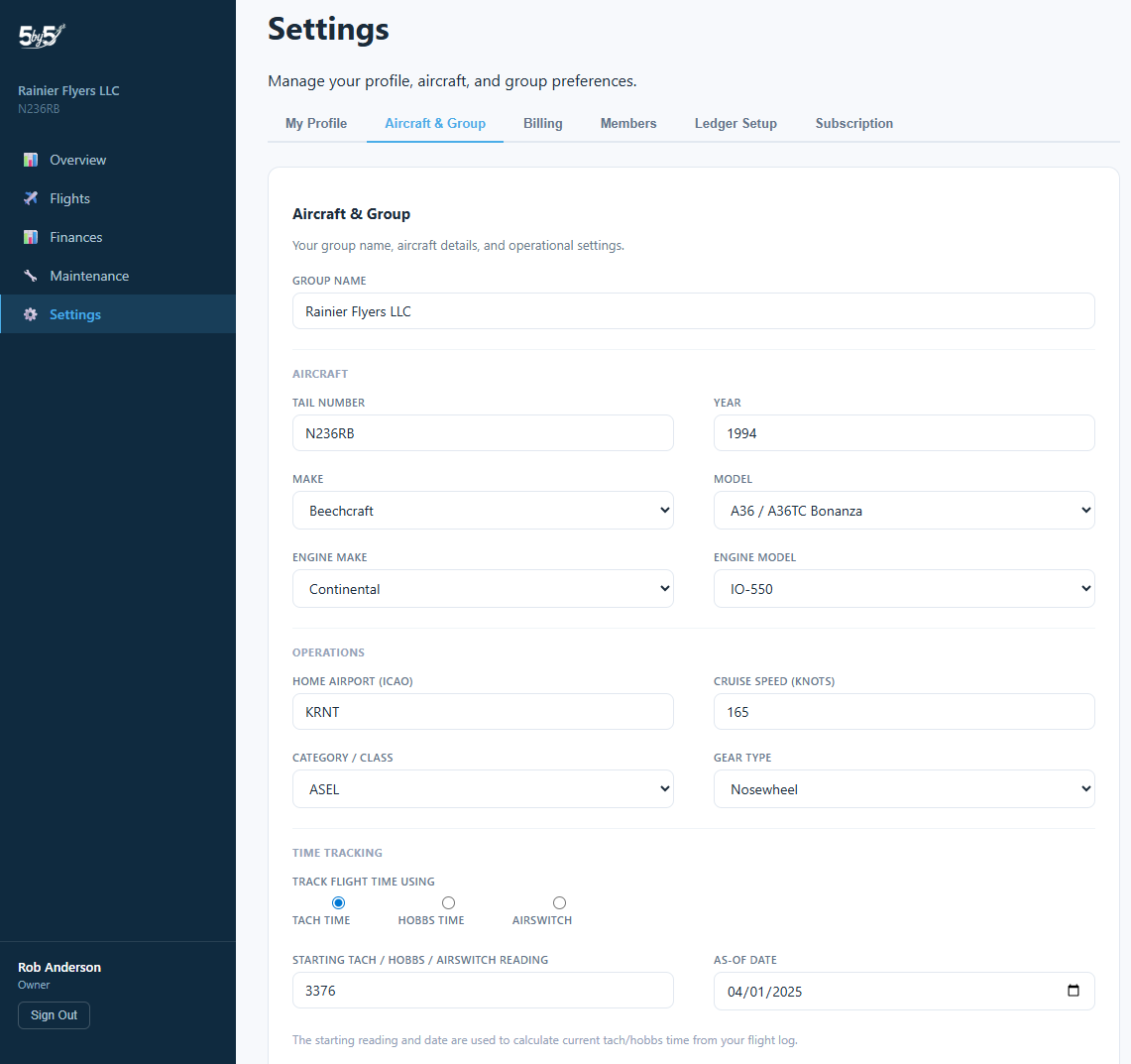
Group — group name and the aircraft tail number, editable here and visible to all members. Also shown (but not editable, on either web or mobile): Country (US/AU — drives currency formatting, regulatory references like FAA vs. CASA, sales tax/GST handling, and phone validation), which is set once during onboarding. Contact support@fly5by5.com if your group needs to change countries.
Aircraft — make, model, year, engine make/model, home airport (with auto-resolved timezone), cruise speed, category/class, gear type (nosewheel vs. tailwheel — drives day-currency landing rules), and time tracking type (Tach, Hobbs, or Airswitch).
Twins — a twin also gets an Engine/Propeller 2 Details section: position (Left/Right, or Front/Rear for a Skymaster), make, family, variant, serial, TBO and overhaul tach for the second engine and its propeller. It appears when the category/class is multi-engine, the make/model is a known twin, or a second engine is already saved, including one set up on the Fleet page. Groups with more than one aircraft set each twin’s second engine on the Fleet page instead.
Aircraft Photo — below the form, single-aircraft groups can set the picture members see at the top of the mobile app. JPEG, PNG or WebP, uploaded as soon as you choose it and resized in your browser first, so a full-resolution phone picture is fine. Groups with more than one aircraft set a photo per airframe on the Fleet page instead.
Aircraft make/model and engine are selected from the shared aircraft catalog. Make and model drive AD lookups, sensible cruise-speed defaults, the bookmarked-by-default manuals in the Documents Library, and category/class for currency tracking. If your make/model isn’t listed, choose Other and email support — we’ll add it.
Flying Club Settings
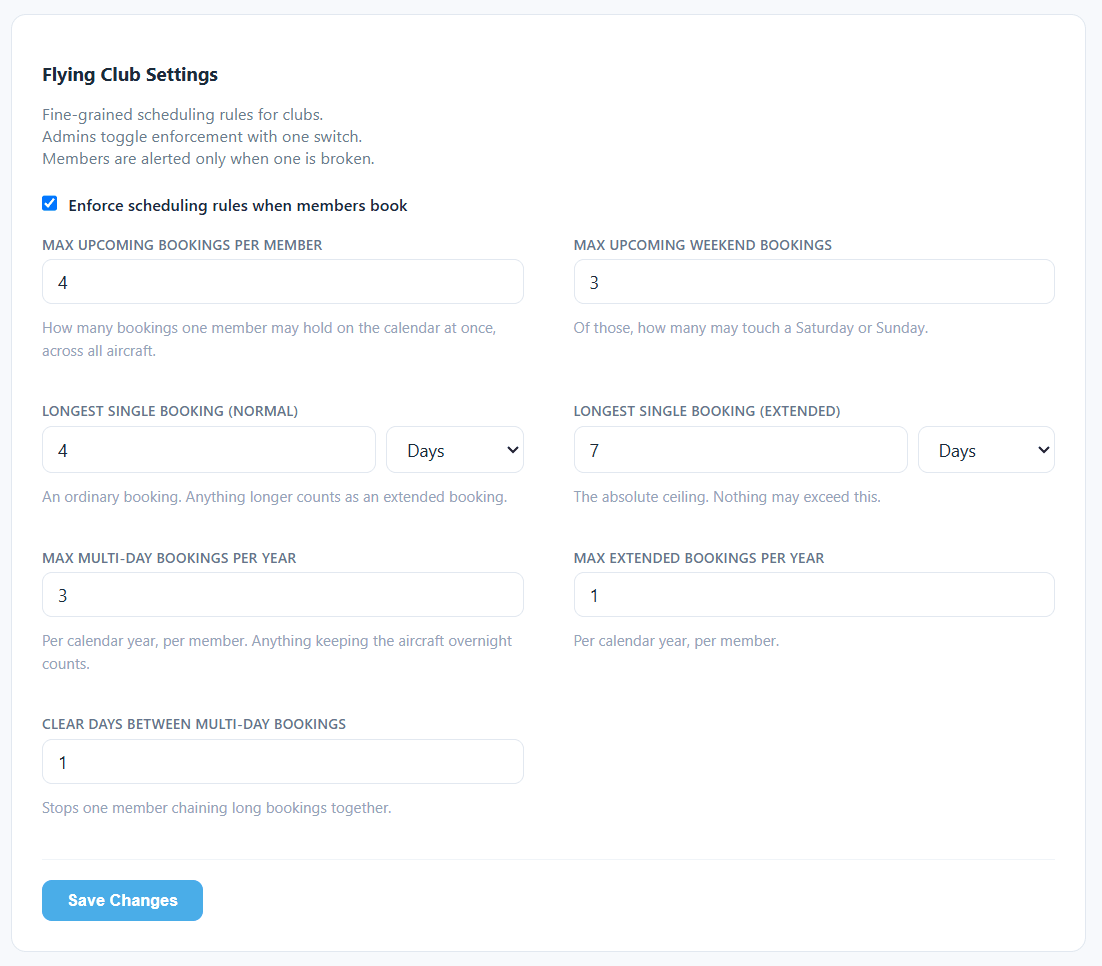
Scheduling rules your club has in writing: max upcoming bookings per member, max upcoming weekend bookings, longest single booking (normal and extended, in days or hours), max multi-day and extended bookings per year, and clear days between multi-day bookings. Leave a rule blank for no limit, and tick Enforce scheduling rules when members book to switch them on. Every club has this card; nothing is enforced until you turn it on. Rules are checked whenever anyone books, in the app or on the web dashboard. See Settings → Scheduling Rules for what members see when a booking breaks one.
Member Experience
What members see when they open 5-by-5. These are the club’s defaults. Each member can change most of them for themselves in My View, just below. If you’ve set something differently for yourself in My View, this card says so and tags that setting (for example your view: Detailed): your own choice still wins for you, so a change to the club default won’t show on your screen. In My View, each of your own choices is tagged with the club’s setting, for example your choice · club: Compact. Once the two agree, the tags go away. Start simple and switch more on as the club is ready.
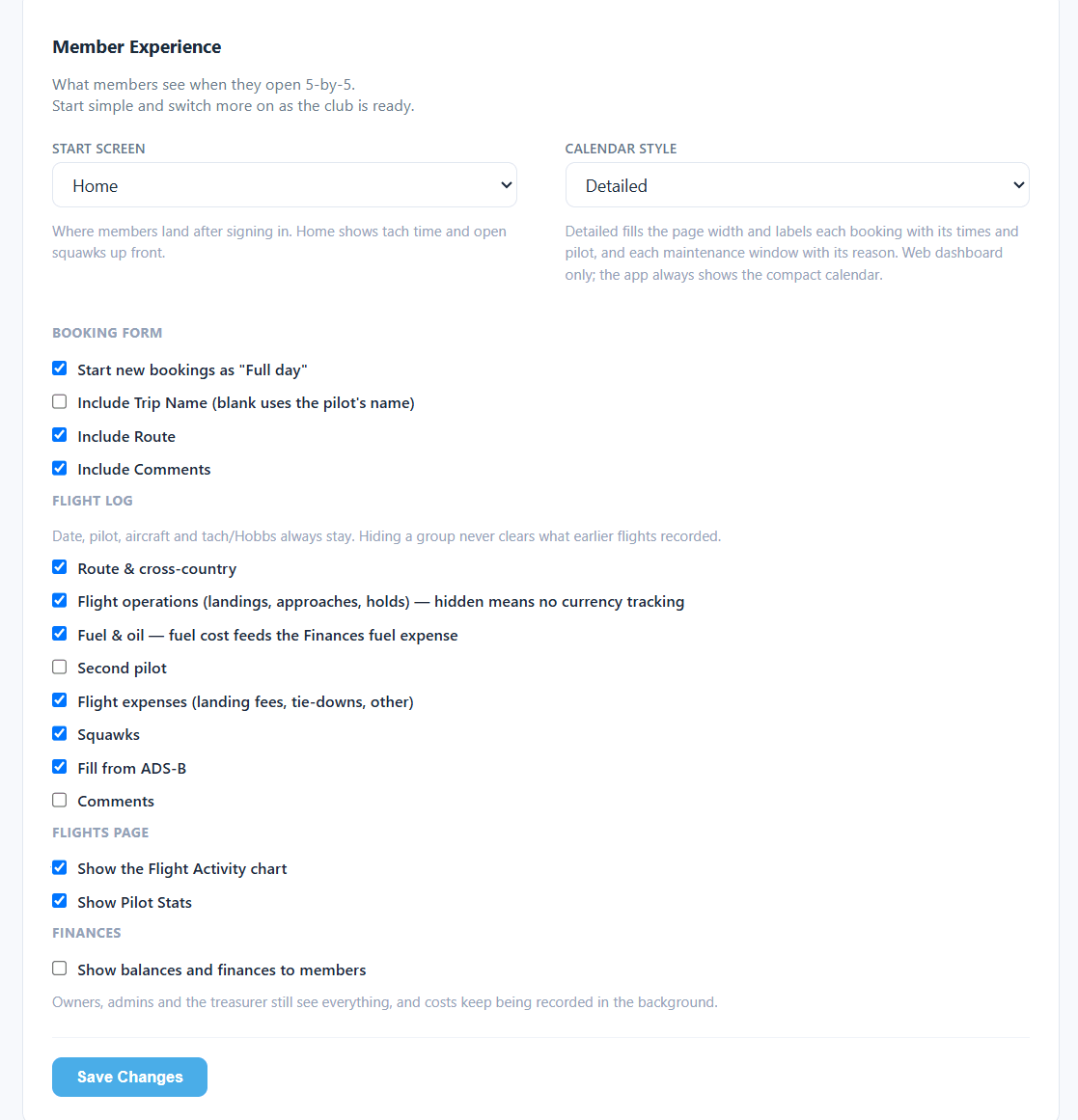
- Start screen — Home or Calendar. Members who pick Calendar land on the Flights page on the web, where the calendar lives, and on the Calendar tab in the app.
- Calendar style — Compact, the same calendar as the app (how to read it), or Detailed, which fills the page width and draws each reservation as a labeled bar with its times and pilot, for example 11:00a Austin S 1:00p, and each maintenance window with its reason. See Flights → Compact and Detailed calendars. This one changes the web dashboard only.
- Booking form — start new bookings as Full day; include Trip Name (blank uses the pilot’s name); include Route; include Comments.
- Flight log — show or hide Route & cross-country, Flight operations (landings, approaches, holds; hidden means no currency tracking), Fuel & oil (fuel cost feeds the Finances fuel expense), Second pilot, Flight expenses, Squawks, Fill from ADS-B, and Comments. Date, pilot, aircraft, and tach/Hobbs always stay, and hiding a group never clears what earlier flights recorded.
- Flights page — Show the Flight Activity chart, Show Pilot Stats, and Show the Flight Log and Flight Details. Turn the first two off and the Flights page opens straight onto the calendar. Turn the Flight Log off as well and the calendar is the whole page: pilots log each flight from their booking with Log Flight, and + Log a Flight moves up beside + Book a Flight for a flight nobody booked.
Owners and admins: hiding the Flight Log hides it for you too. If you still want it for checking tach entries or correcting a flight, turn it back on just for yourself in My View.
The same settings appear in the app under Settings → Flying Club Settings → Member Experience. See Settings → Member Experience.
My View
Every club member, not just owners and admins, has a My View card on the My Profile tab: the same choices as Member Experience above, set just for you. Start screen, Calendar style, the booking-form and flight-log switches, and the Flights page switches are all there.
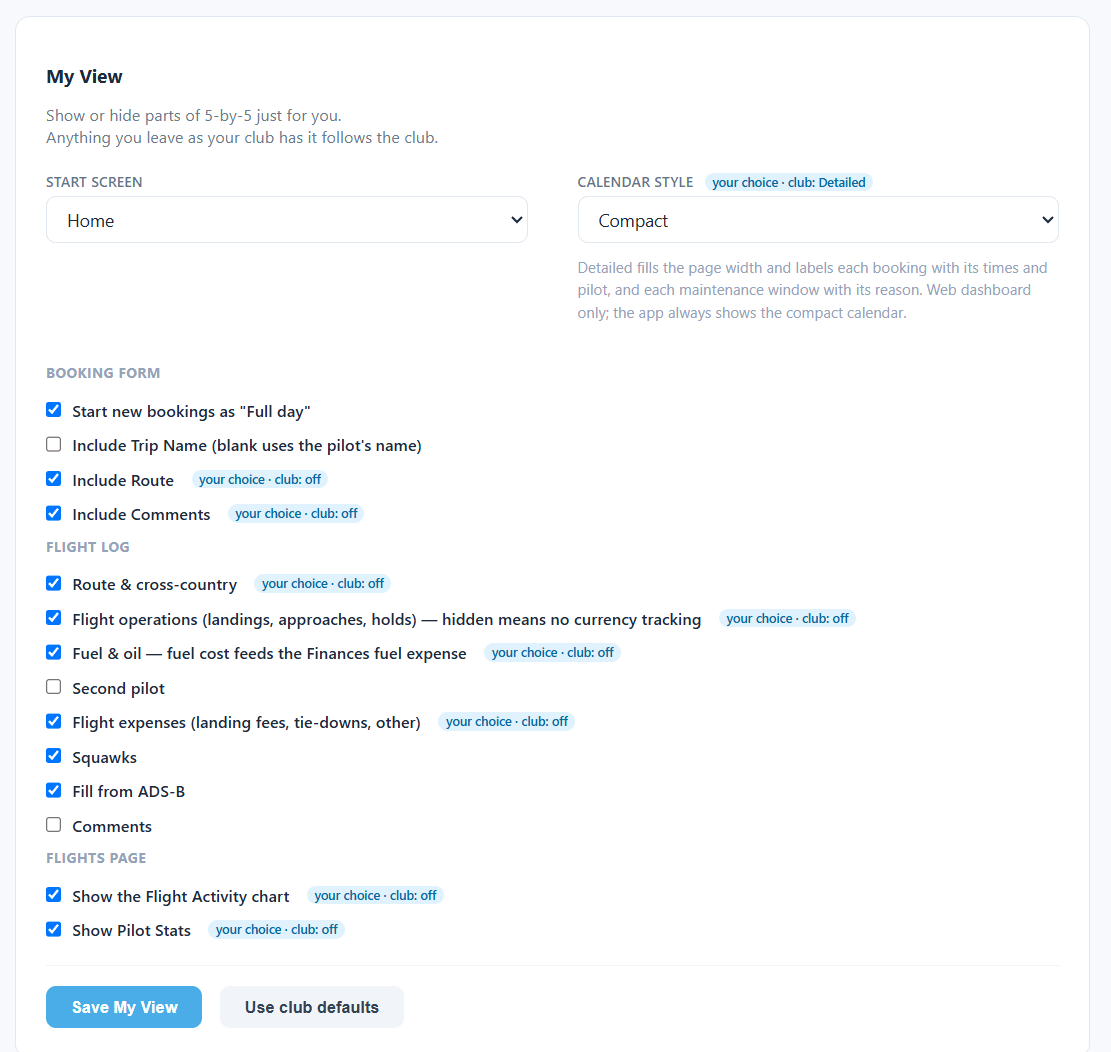
- Anything you leave as your club has it follows the club, so a later change by an admin still reaches you.
- Anything you set differently is marked your choice.
- Click Save My View to keep your changes, or Use club defaults to drop all of them.
Show balances and finances to members isn’t in My View: who sees the club’s money is the club’s decision. The app has the same card, and your choices apply on both. See Settings → My View.
Billing
The densest tab. Five cards drive how monthly billing is calculated, taxed, and collected.
Billing & Rates
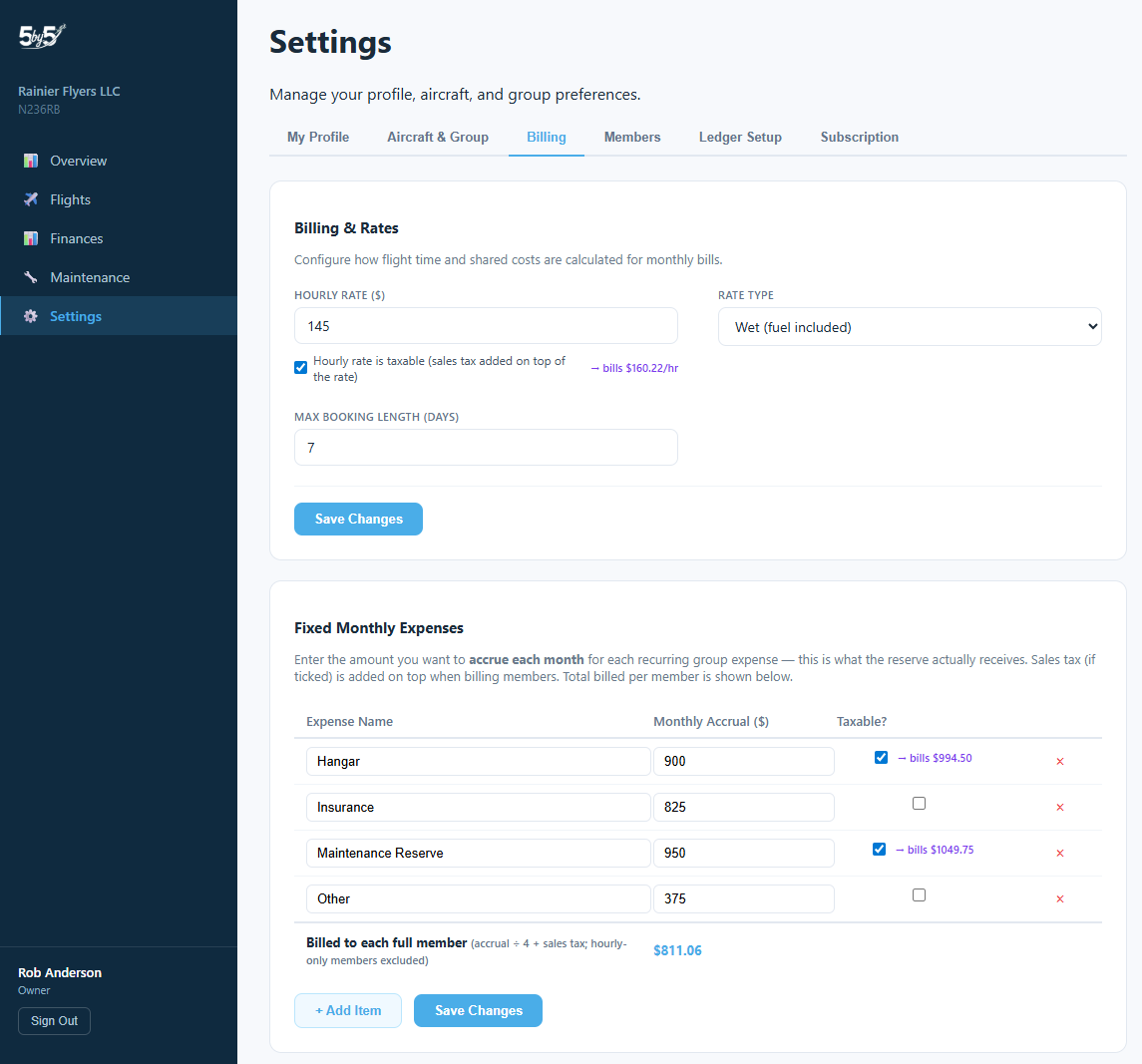
Hourly rate, rate type (Wet = fuel included; Dry = fuel billed separately), maximum booking length, the single Monthly Fixed Cost figure, and the day of the month bills are due. The single Monthly Fixed Cost is what each member’s bill uses unless you enable the per-line-item breakdown in the next card.
Fixed Monthly Expenses
A per-line-item breakdown of your monthly fixed cost — e.g., “$450 hangar, $200 insurance, $100 reserve.”
Enter the amount you want to set aside each month, not the amount of the bill. For anything billed annually — insurance, the annual inspection — divide by twelve: a $2,400 policy is $200 a month. What the group actually pays out, and when, is tracked separately as a Planned Expense.
Multi-aircraft groups get an Aircraft column on each row. Tag a cost to the airframe it belongs to, or leave it on Whole group for things that aren’t one airplane’s (club liability, dues). Tagged totals appear per aircraft on the Fleet page. It’s a reporting tag only — every item is still pooled and split equally. If one member should pay a different share, use an individual adjustment on their bill. When you fill this in, the Member Expenses table and invoice emails both show the breakdown so members understand what their fixed share is funding. The line items also feed the Fixed Expense Items columns on the Sales Tax Report so tax accrues only against the items each authority is configured to tax. Mechanics and hourly-only members are excluded from the fixed-cost split — see Finances → Hourly-Only Members.
Sales Tax Authorities
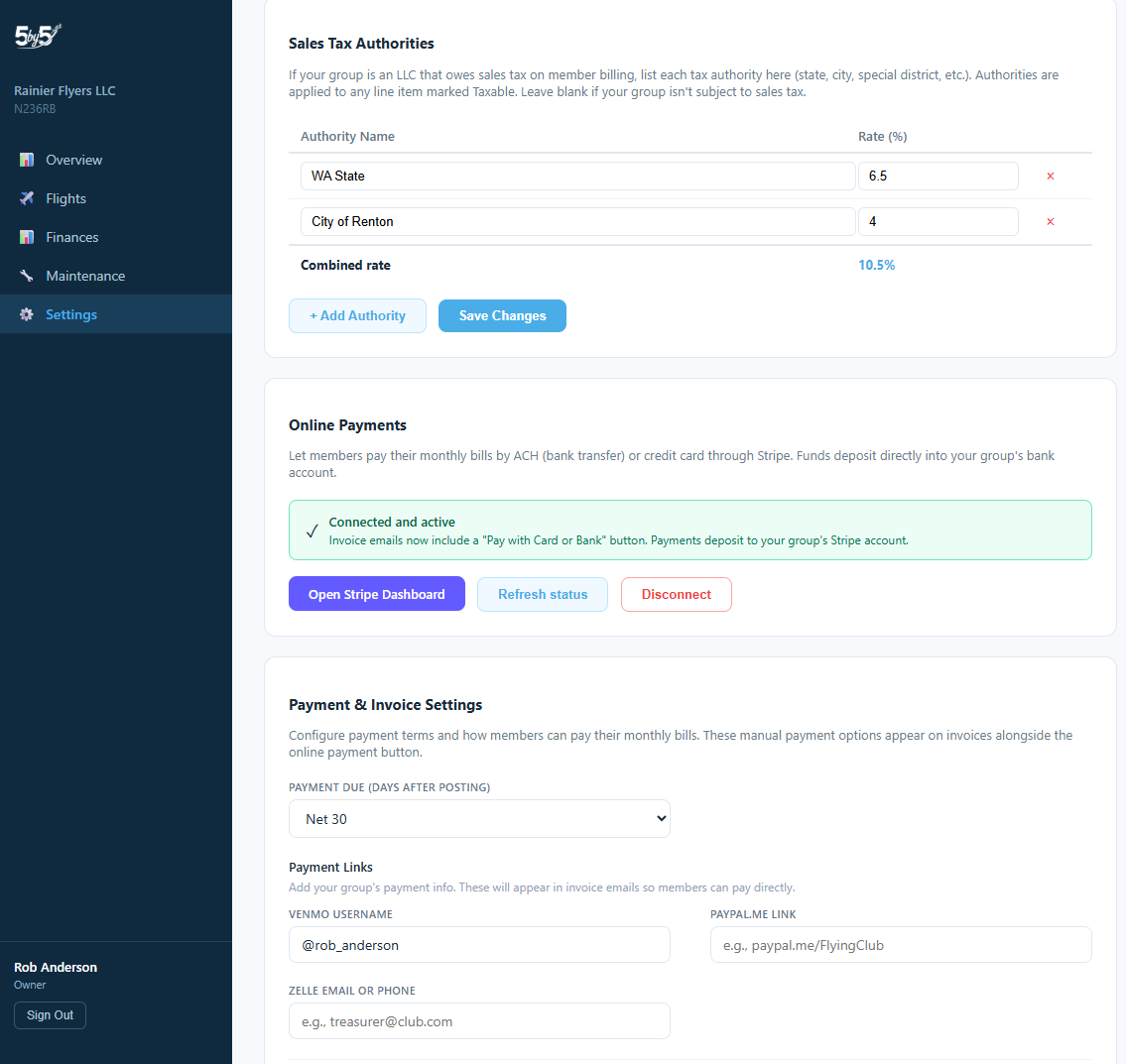
Configure the state, city, county, or other tax authorities that apply to your group. For each authority specify the rate and which categories (flight charges, fixed expenses, shared group charges) the tax applies to. The Post Bills flow then writes per-authority tax accruals to the group’s tax ledger, which drives the Sales Tax Report.
This card is editable only on the web. The mobile app surfaces tax authority effects on bills but doesn’t let you create or edit authorities themselves — that’s by design, since this is a low-frequency administrative setup, not a daily-use operation.
Online Payments (Stripe Connect)
This is where Stripe Connect onboarding happens. Click Connect Stripe to start the flow — you’ll be redirected to Stripe to provide standard business info (group name, address, bank account, EIN if applicable). Once Stripe approves, the Pay with Card or Bank button starts appearing on every posted invoice and ACH/card payments settle directly to the group’s bank account.
For the full Online Payments lifecycle (ACH settlement timing, the Update pending badge, processing fees, what to expect when a payment bounces), see Finances → Online Payments.
Payment & Invoice Settings
Configure the payment due day, late fee policy, reply-to email address used on invoices, and any custom invoice footer text. This is the card that personalizes how invoices look and behave once Stripe Connect is live.
Members
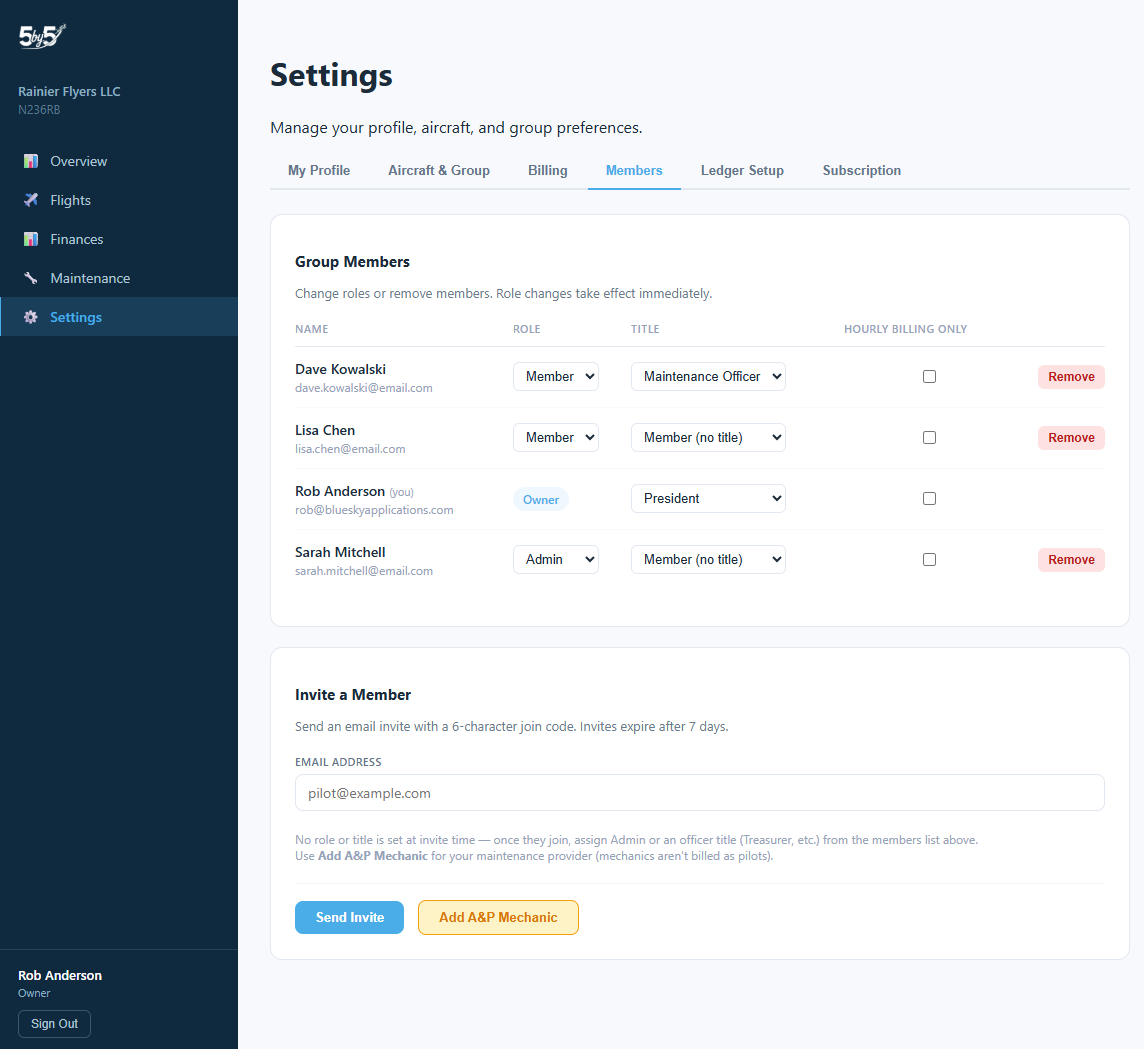
Owners and Admins manage the group’s roster from here — roles, titles, invites, and the per-member Hourly billing only toggle that drives the fixed-cost denominator on the Finances page.
Message Members — write to some or all of your members. Each one gets their own email from you, via 5-by-5, plus a copy in their Notification Center. See Members & Roles → Messaging Members.
Group Members — every active member with name, email, role (Owner / Admin / Member / Mechanic), and title (Treasurer, Maintenance Officer, etc.). Click a member to expand them and edit role, title, Hourly billing only flag, and contact info — or to remove them from the group.
A warning pill next to a member — Email bouncing, Marked our email as spam, or Email blocked — means our emails aren’t reaching them. Hover over it for details. They still get every notice in the Notification Center; check their address with them. See Notification Center → When a Member’s Email Isn’t Getting Through.
Invite a Member — generate an invite link or short code. Pick a role for the invite (Member or Mechanic) so the invitee lands in the right scope when they sign up. The join flow also surfaces any placeholder members created from imports so the joiner can claim the right historical record.
See Members & Roles for the full role permission matrix, A&P Mechanic Access scope, and the Maintenance Officer / Treasurer title behaviors.
Ledger Setup
A small but important tab — Member Opening Balances. Use it when migrating a group from a spreadsheet or another tool, where each member’s ledger should start at a specific balance rather than $0.
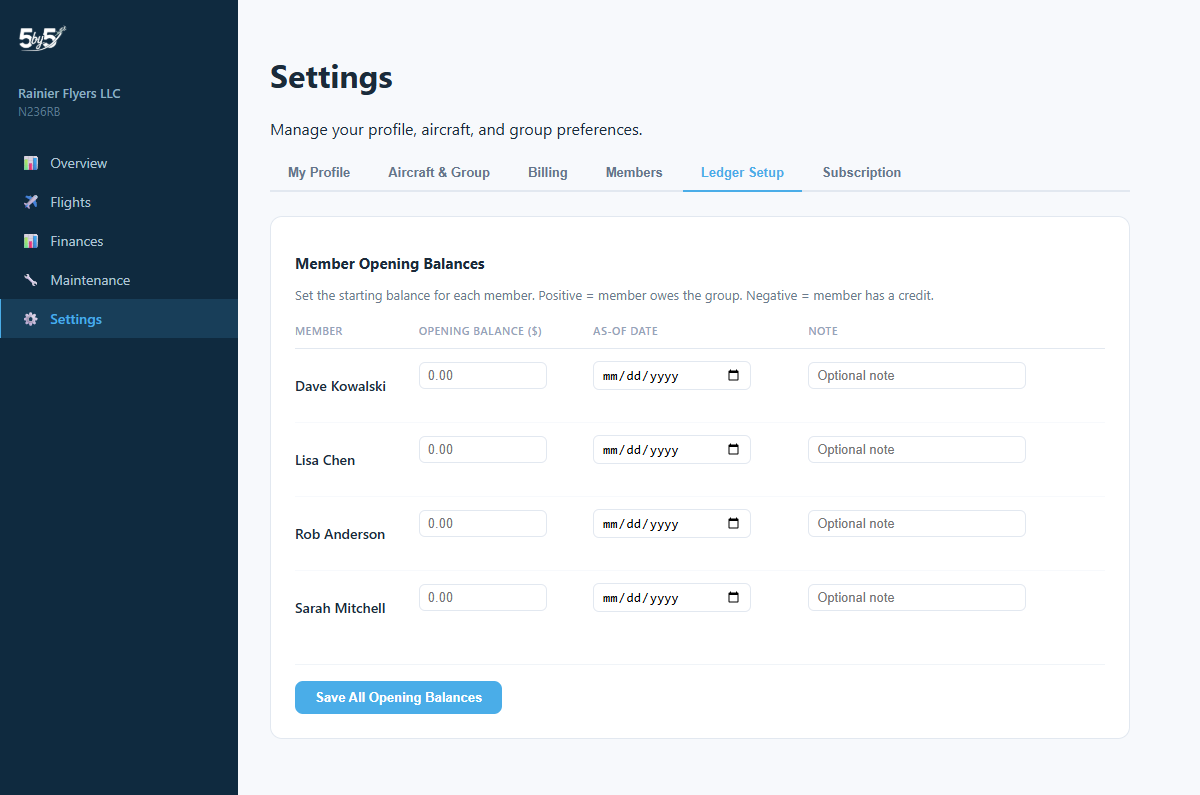
For each member, enter the opening balance — positive means they owe the group, negative means they have credit — and the as-of date. 5-by-5 writes an opening_balance row into each member’s ledger as of that date. Every charge, payment, and adjustment after that flows normally on top of the opening balance.
This is typically a one-time setup. If you need to adjust a balance later, do it as an adjustment entry in the Member Ledger on the Finances page rather than editing the opening balance — the audit trail is cleaner that way.
Subscription
Visible only to the group Owner. Shows the current plan tier, billing cycle, next renewal date, payment method, and the upgrade/downgrade controls.
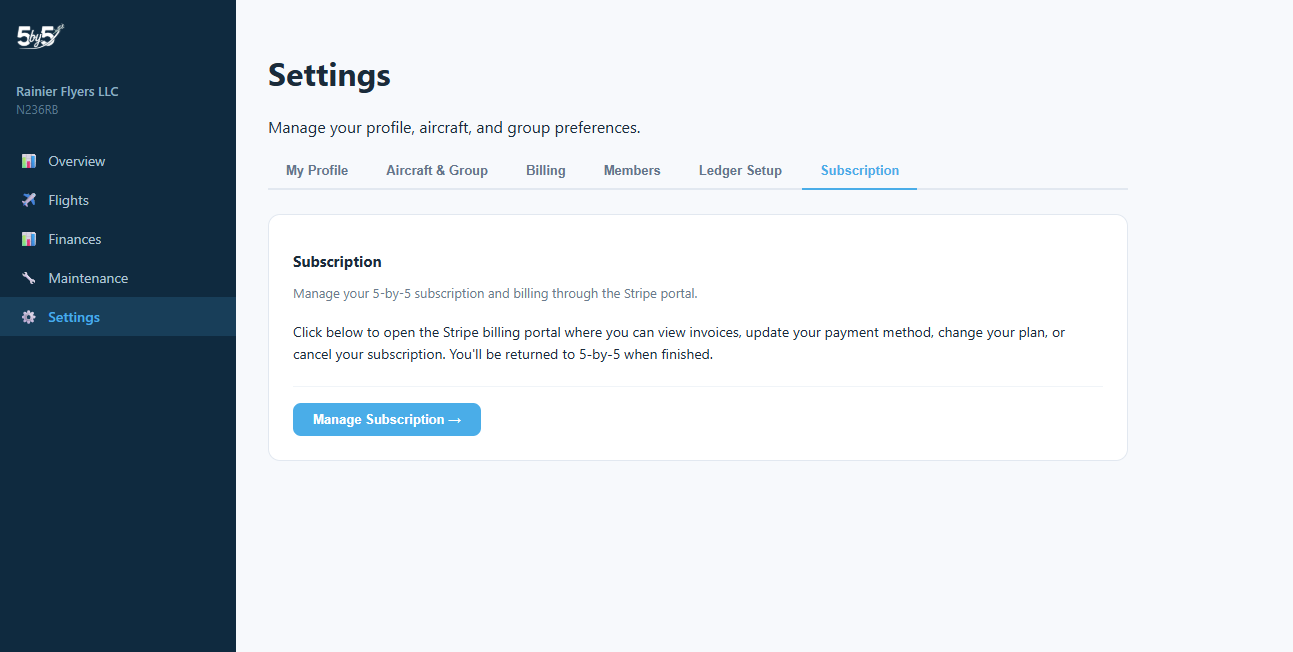
The group’s SaaS subscription is billed to the Owner’s personal payment method via 5-by-5’s billing system. This is separate from Stripe Connect — the Stripe account you configured on the Billing tab is for collecting member payments, not for paying the 5-by-5 subscription itself. The two flows don’t share data.
For plan comparisons (Free vs. Solo vs. Club, AU pricing, and what each tier includes), see Billing & Subscriptions.
Related Pages
- Mobile Settings — the matching mobile-app screen, including the configuration items that are view-only on mobile
- Members & Roles — full role permission matrix and title behaviors
- Finances — where the rates, fixed expenses, sales tax, and ledger you configure here actually drive billing
- Online Payments — the ACH and card payment lifecycle from the member’s perspective
- Billing & Subscriptions — 5-by-5 plan tiers and what each includes
- Email Notifications — categories controlled by the Email Preferences card
- Notification Center — the bell, Message Members’ in-app copies, and the email-problem pills on the Members tab