Squawk Reporting
Report and track aircraft discrepancies with severity levels, photos, and automatic email alerts to mechanics.
Overview
Squawks are a way to report and track aircraft discrepancies — anything from a minor cosmetic issue to a grounding safety concern. 5-by-5 makes it easy to report squawks and automatically notifies the right people the moment a discrepancy is filed.
Where Squawks Appear
Active squawks are visible in several places:
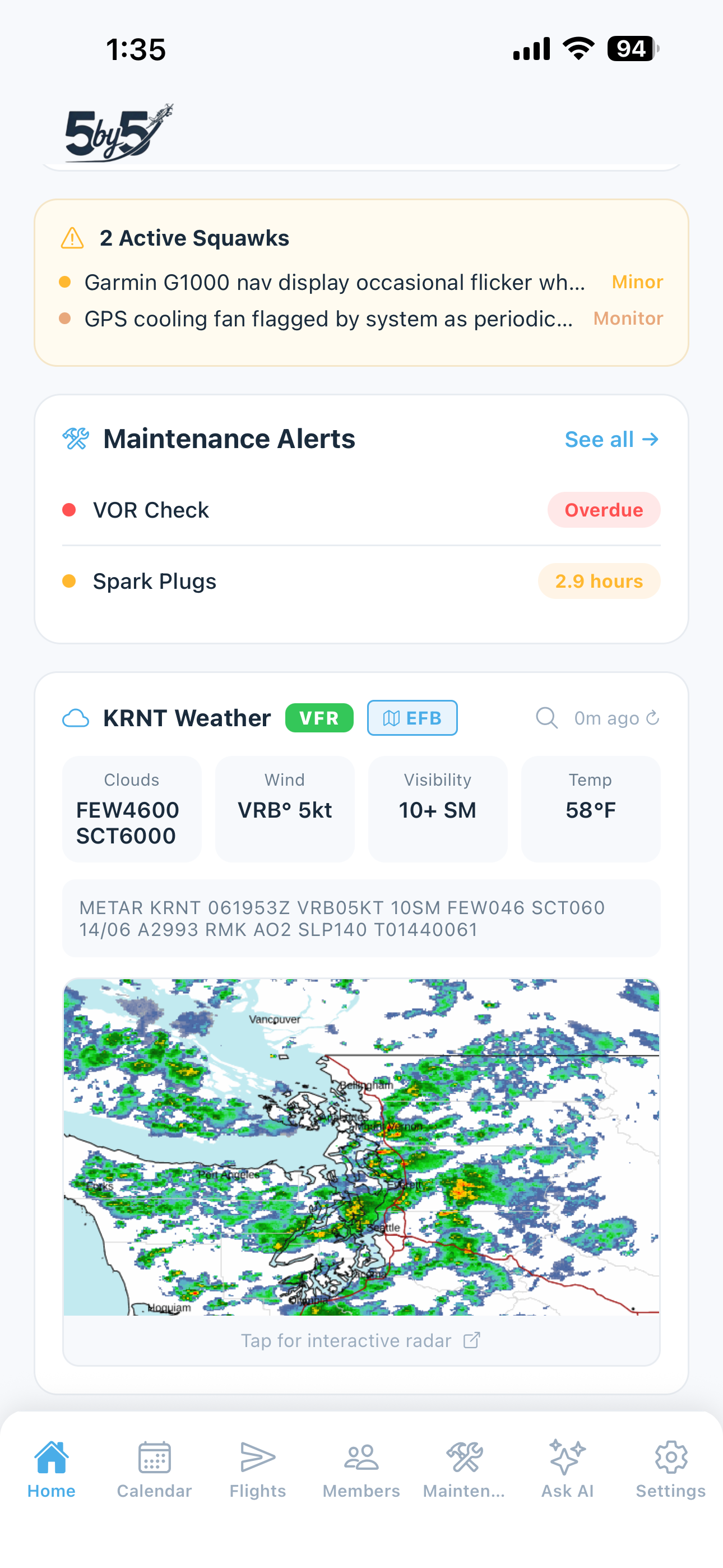
- Home dashboard — grounding squawks in the red banner, non-grounding squawks in the yellow squawks banner
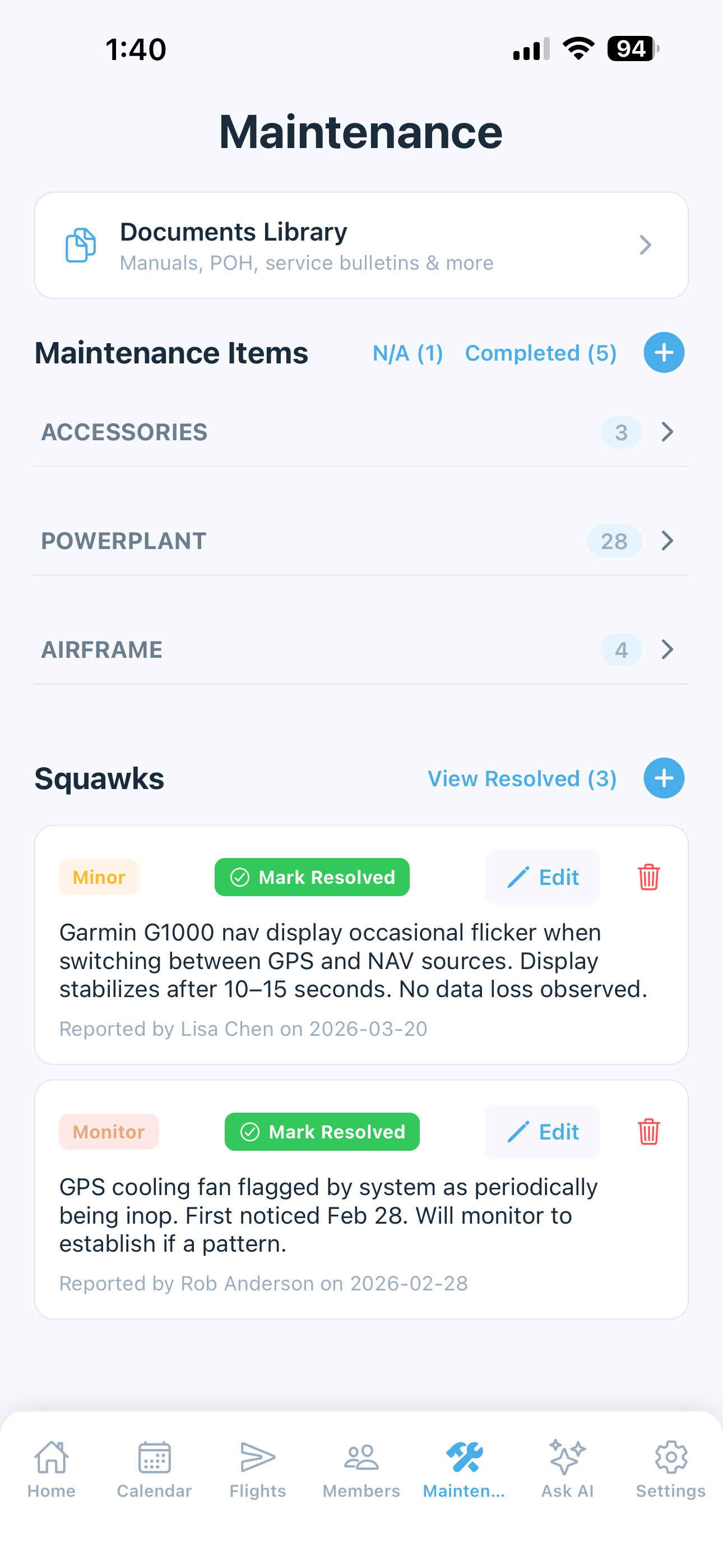
- Maintenance screen — full list with open and resolved sections
- Flight cards — flights with associated squawks show a maintenance badge
- Web dashboard Maintenance page — full management view for owners, admins, and mechanics
- Calendar — open squawks are listed above the calendar on mobile and the web dashboard
- Email — new squawks are emailed to the whole group: mechanics, maintenance officers, owners, and admins on the To: line, every other member CC’d (see Email Notifications below)
- Notification Center — the same alert appears in everyone’s notification bell, in case the email went to spam
Reporting a Squawk
You can report squawks in two ways:
From a Flight
When logging a flight, scroll to the Squawks section:
- Tap Add Squawk
- Describe the issue
- Select the severity level
- Optionally attach a photo (paid tiers only)
Standalone
From the Maintenance screen, you can add squawks that aren’t tied to a specific flight:
- Scroll to the Squawks section at the bottom of the page
- Tap the + button to add a new squawk
- Fill in description, severity, and optional photo (paid tiers only)
You can also file a squawk from the web dashboard via the Maintenance page → Active Squawks → + Report.
Who Can Do What
The same rules apply in the app and on the web dashboard:
| Action | Who |
|---|---|
| Report a squawk | Anyone in the group |
| Resolve a squawk | Owners, Admins, A&P Mechanics, and the Maintenance Officer |
| Edit or delete a squawk | Whoever reported it, plus Owners and Admins |
Squawk Photos (Paid plans)
Paid plans (Solo and Club) can attach photos to squawk reports. This is especially useful for documenting visible issues like:
- Cracks or damage
- Fluid leaks
- Tire condition
Photos also make it easy to share the issue directly with your mechanic — a quick snapshot from the ramp is often worth more than a written description.
Free tier users can report squawks with text descriptions only.
Severity Levels
Each squawk is assigned one of three severity levels:
- Minor — cosmetic or non-urgent issues (e.g., a small scratch, worn seat fabric)
- Monitor — items to watch but not immediately grounding (e.g., slight oil seepage, intermittent avionics alert)
- Grounding — issues that make the aircraft unairworthy or unsafe to fly (e.g., flat tire, cracked windshield, engine vibration)
Severity drives:
- Where the squawk appears on the home screen (grounding gets the red banner; monitor and minor go in the yellow squawks banner)
- The color of the email alert header (red, orange, or amber)
- Whether the airplane is effectively grounded for other members
Grounding Alerts
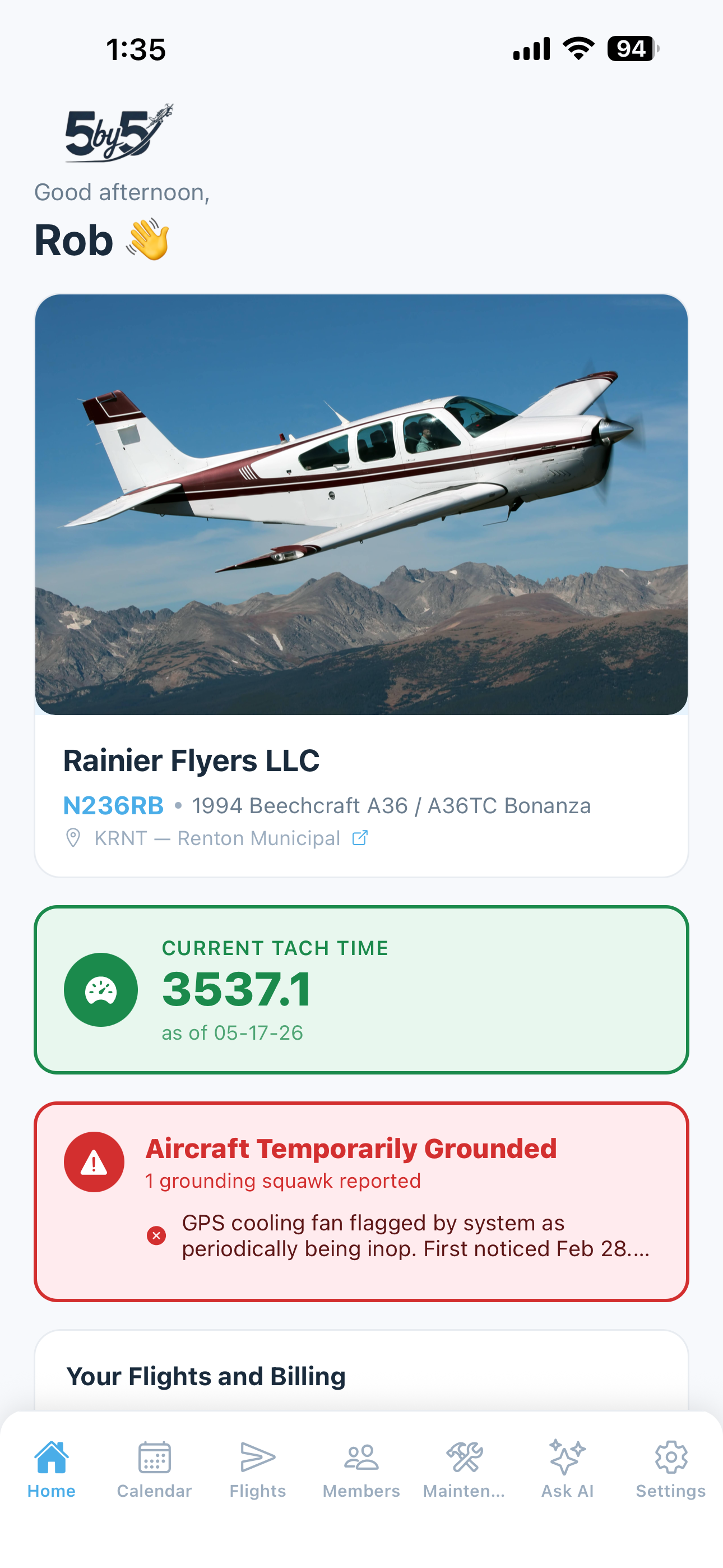
When a squawk is marked Grounding, a bold red banner appears on every group member’s home dashboard showing:
- The total count of grounding squawks
- A description of each grounding issue
This ensures that no one flies the airplane while a grounding issue is active.
Maintenance Windows (Club)
A grounding squawk doesn’t just warn people — it takes the aircraft out of service for a span of time, and tells anyone with a booking in that span.
There are two ways an aircraft comes out of service, and they work differently because they start differently.
Unplanned: something is wrong now
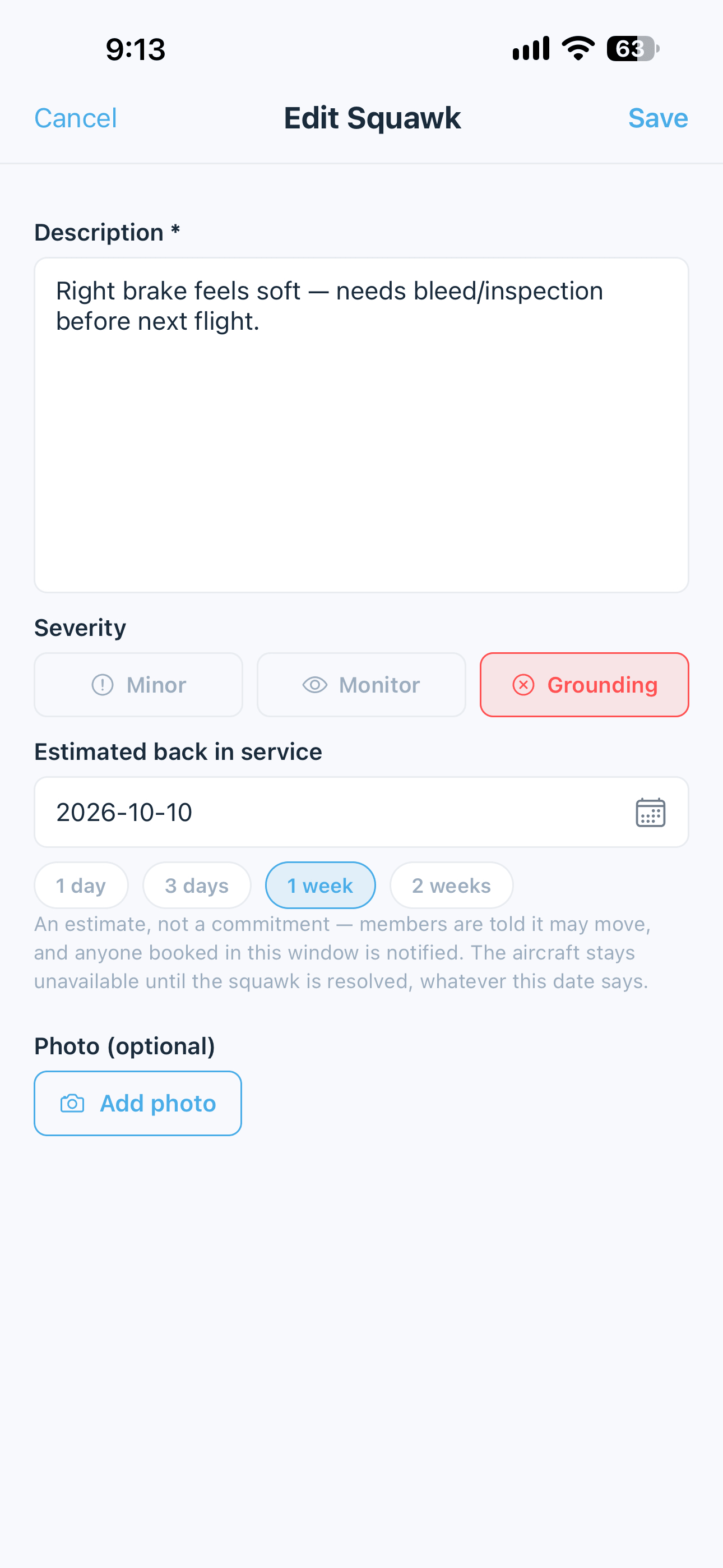
File a grounding squawk the way you always have. You don’t enter any dates — the aircraft is down as of now, and the estimated return defaults to one week.
That default is deliberate. A pilot who has just found metal in the oil filter shouldn’t have to fill in a form, and shouldn’t find it easier to file the problem as Minor just to avoid one. So the app takes a guess and then asks someone qualified to replace it: your mechanic and maintenance officer are emailed to set a real return-to-service date.
Until one of them does, the window shows as estimated everywhere it appears. Once they set a date, it reads as confirmed.
Planned: an annual, an oil change
Scheduled work is booked from the Calendar, because that’s where scheduling lives — see Scheduling. It still creates a grounding squawk behind the scenes, so there’s one record and one way to close it out.
Who can set a return date
Owners, Admins, anyone invited as an A&P Mechanic, and anyone whose club title is Maintenance Officer. Everyone else files squawks exactly as before — the date fields simply don’t appear for them.
If your club has no mechanic or maintenance officer, the request to set a date goes to the owner and admins instead, so it never goes nowhere.
If the work runs late
At 5pm on the last day of the window, if the squawk is still open, the window extends by a day and anyone whose flight is now affected is emailed. That repeats daily until the squawk is resolved.
The timing balances two needs: the mechanic gets the whole of the last day before anyone is told the work is slipping, and a pilot flying tomorrow morning still hears the evening before, with time to make other plans. 5pm is local to your club, from your home airport.
The estimate never puts the aircraft back in service. Only resolving the squawk does that. An estimate that has passed means the window is overdue, not over — the aircraft stays unavailable until someone says the work is done.
What members see
- Home screen — a red Aircraft Temporarily Grounded banner once the window has started. Scheduled work that hasn’t begun yet shows as an amber Scheduled Maintenance Coming Up banner with the dates, because the aircraft is still perfectly flyable until then.
- Calendar — a red band on every affected day, on both mobile and the web dashboard.
- Their booking — marked Standby, not cancelled. See Scheduling.
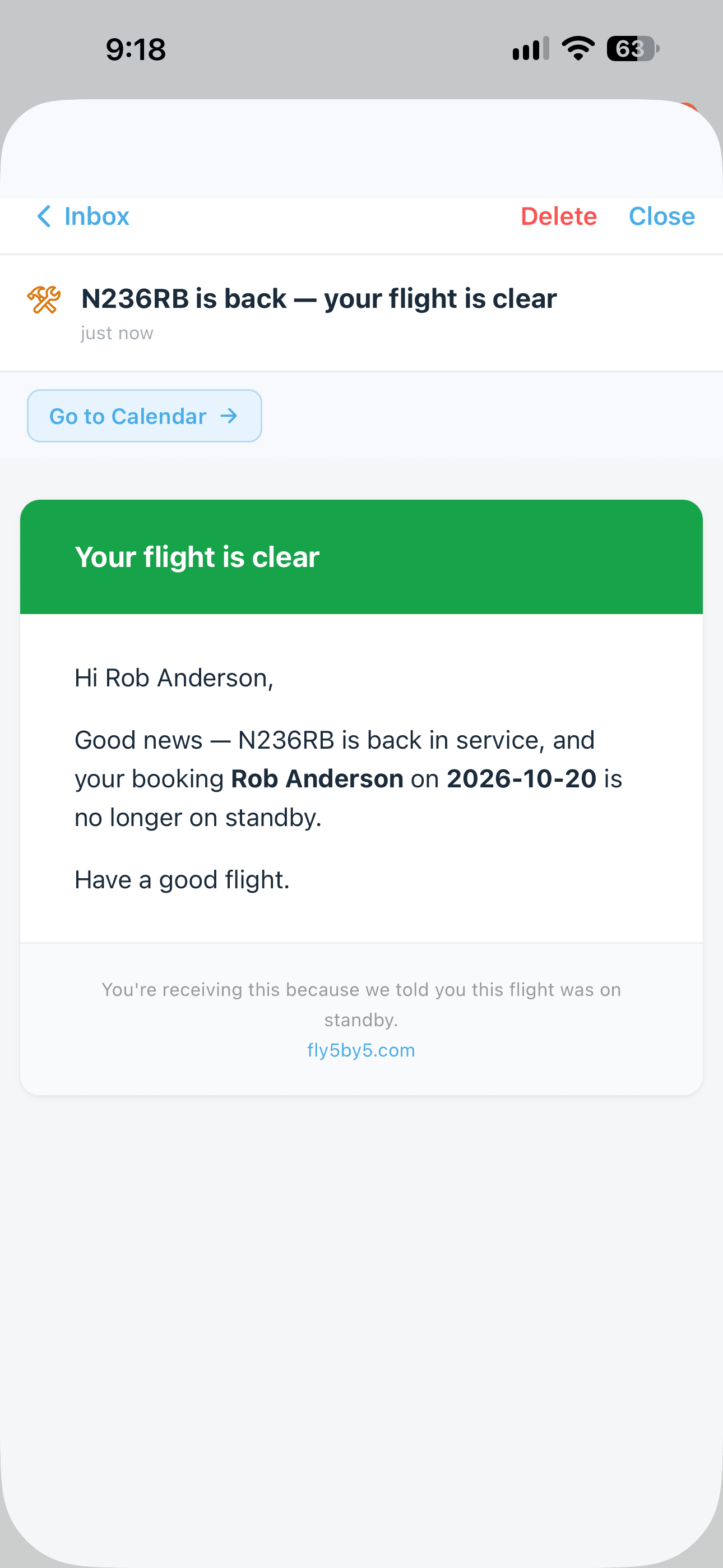
- Their inbox — an all-clear when the aircraft is back, so nobody has to check whether their flight is still on.
Email Notifications (Paid plans)
The moment a squawk is filed — from mobile flight logging, the standalone reporter, or the web dashboard — 5-by-5 automatically emails everyone in the group. Every pilot hears about a new squawk, and the people responsible for fixing it are addressed directly.
Who Receives It
To: the people responsible for the aircraft — every member with role = Mechanic OR a title containing “Maintenance” (e.g., “Maintenance Officer”, “Maintenance Coordinator”), plus every Owner and Admin. Title matching is case-insensitive, so minor variations still count.
CC: every other active member, so no pilot is surprised by a squawk they didn’t hear about. Whoever filed the squawk isn’t sent a copy of their own report, and members who have left the group are never emailed.
If nobody responsible has an email address on file, the alert is addressed to the rest of the group instead, so it still reaches someone.
What the Email Contains
- Aircraft tail number
- Squawk severity (with the email header color-coded — red for grounding, orange for monitor, amber for minor)
- Description of the issue
- Reporter’s name
- Link to view the squawk photo (if one was attached)
- Link back to the maintenance screen on the web dashboard
What if I’m Not Getting Squawk Alerts?
If you’re in the group but not receiving alerts, the most likely cause is your email provider filtering the message into spam. The first email from maintenance@fly5by5.com typically lands in junk in Gmail and Outlook.
The fix:
- Check your spam folder for an email from
maintenance@fly5by5.com - Mark it Not Spam
- Add the sender to your contacts
See Email Notifications > Keeping 5-by-5 Emails Out of Spam for provider-specific instructions.
Opting Out
Squawk alerts are transactional and cannot be disabled in the Communications settings — and since September 2026 they reach every member, not only the maintenance roles. They stay on by design: a squawk affects anyone who might fly the aircraft next, so the whole group hears about it. Turning off product tips in Communications has no effect on them.
Resolving Squawks
Owners, Admins, A&P Mechanics, and the Maintenance Officer can resolve a squawk. When a squawk has been addressed:
- Go to the Maintenance screen (mobile or web)
- Navigate to the Squawks section at the bottom of the page
- Tap to expand the target squawk and select Mark Resolved
- Add optional Resolution Notes describing how the issue was addressed
- Attach an optional resolution photo (paid plans — Solo and Club)
- Tap Save to complete the resolution
Resolved squawks can be viewed by tapping the View Resolved button next to the + icon.
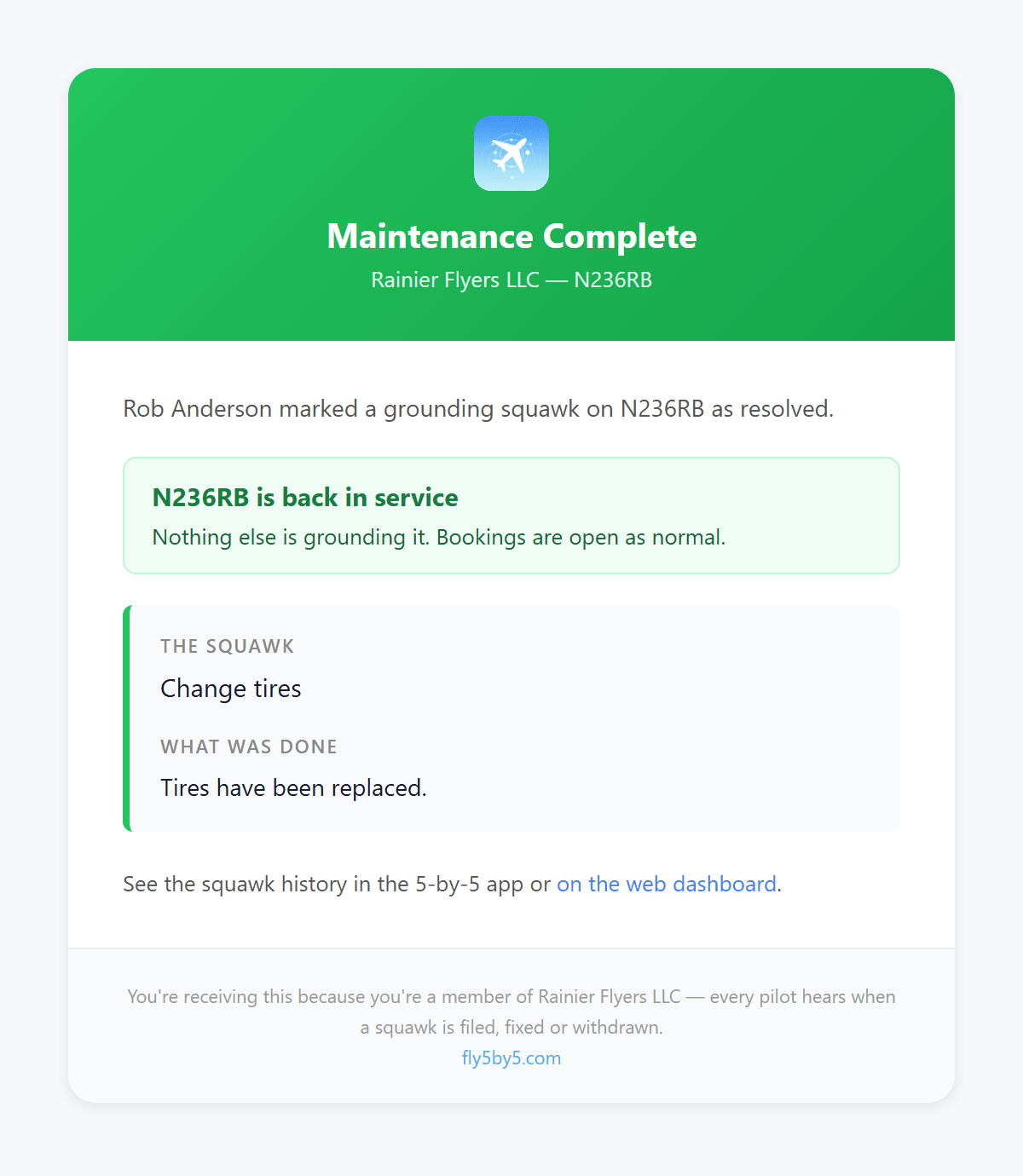
Resolving a squawk tells the whole group, by email and in the Notification Center, with the same To: and CC split as the original alert. The email carries the resolution notes and photo. If that squawk was the last thing grounding the aircraft, the subject reads Back in service; if another grounding squawk is still open, the email says the aircraft is still grounded and why. Whoever resolved it isn’t sent a copy.
Editing a Squawk
If a squawk was filed with a typo or the severity needs adjusting, whoever reported it, or any Owner or Admin, can edit it:
- Open the squawk in either the mobile app or the web dashboard
- Tap Edit
- Update the description, severity, or attached photo
- Save
Editing the severity from non-grounding to grounding (or vice versa) triggers immediate UI updates everywhere — the grounding banner appears or disappears as appropriate. A second alert email is NOT sent on edit, by design, to avoid duplicate noise.
Deleting a Squawk
Delete a squawk when it shouldn’t have been filed, and resolve it when the work was actually done. Whoever reported it, or any Owner or Admin, can delete it:
- Open the squawk
- Tap the trash icon
- Confirm
Deleting an open squawk tells the group it was withdrawn, by email and in the Notification Center, so nobody keeps planning around a problem that isn’t there. The subject reads Squawk Withdrawn, or Maintenance Cancelled for planned work. If it was holding a maintenance window, members whose bookings were on standby are told their flight is clear. Whoever deleted it isn’t sent a copy.
Deletion is logged in the activity log for the group.