Maintenance Tracking
Access your Documents Library and track inspections, ADs, oil changes, and other maintenance items with automatic due-date calculations.
Overview
The Maintenance screen is your hub for aircraft documentation and maintenance tracking. At the top of the screen you’ll find the Documents Library button, followed by your scheduled maintenance items, and at the bottom, any open squawks.
This page covers the Documents Library and planned maintenance items. For squawks, see Squawk Reporting.
Groups managing more than one aircraft see the aircraft picker at the top of this screen too — see The Aircraft Picker for how it works. Maintenance items and squawks are scoped to whichever tail is selected.
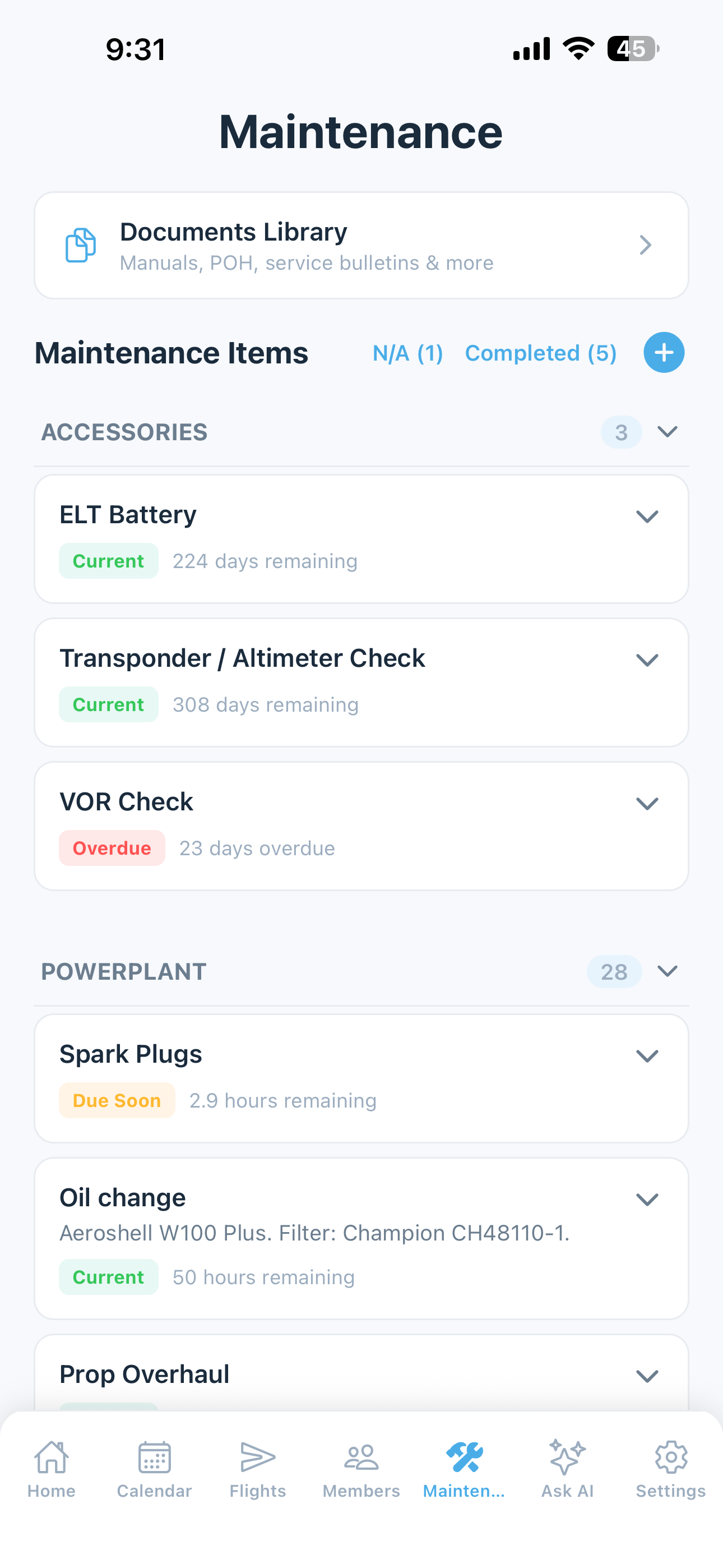
Documents Library (Paid plans)
The Documents Library gives you access to your aircraft’s key reference documents directly in the app. Tap the Documents button at the top of the Maintenance screen to open it.
The library includes:
- POH / AFM — Pilot’s Operating Handbook or Airplane Flight Manual
- Engine Manual — manufacturer’s engine manual
- Avionics Operating Manuals — manuals for installed avionics (Garmin, Avidyne, S-TEC, and similar)
- Your uploads — any documents you’ve added (supplements, STCs, insurance certificates, etc.)
Owners and admins can upload: tap the + button in the Documents Library and select a file from your device. Other members can read and search what has been uploaded, but not add to it.
The Documents Library is also accessible from the web dashboard, and syncs with your mobile app — anything you upload or bookmark on one is available on the other.
Documents are pulled from our shared database. If you want a copy available offline, save it to your device after opening it.
The Documents Library is available on paid Solo and Club plans. Free tier users will be prompted to upgrade when they tap the Documents button.
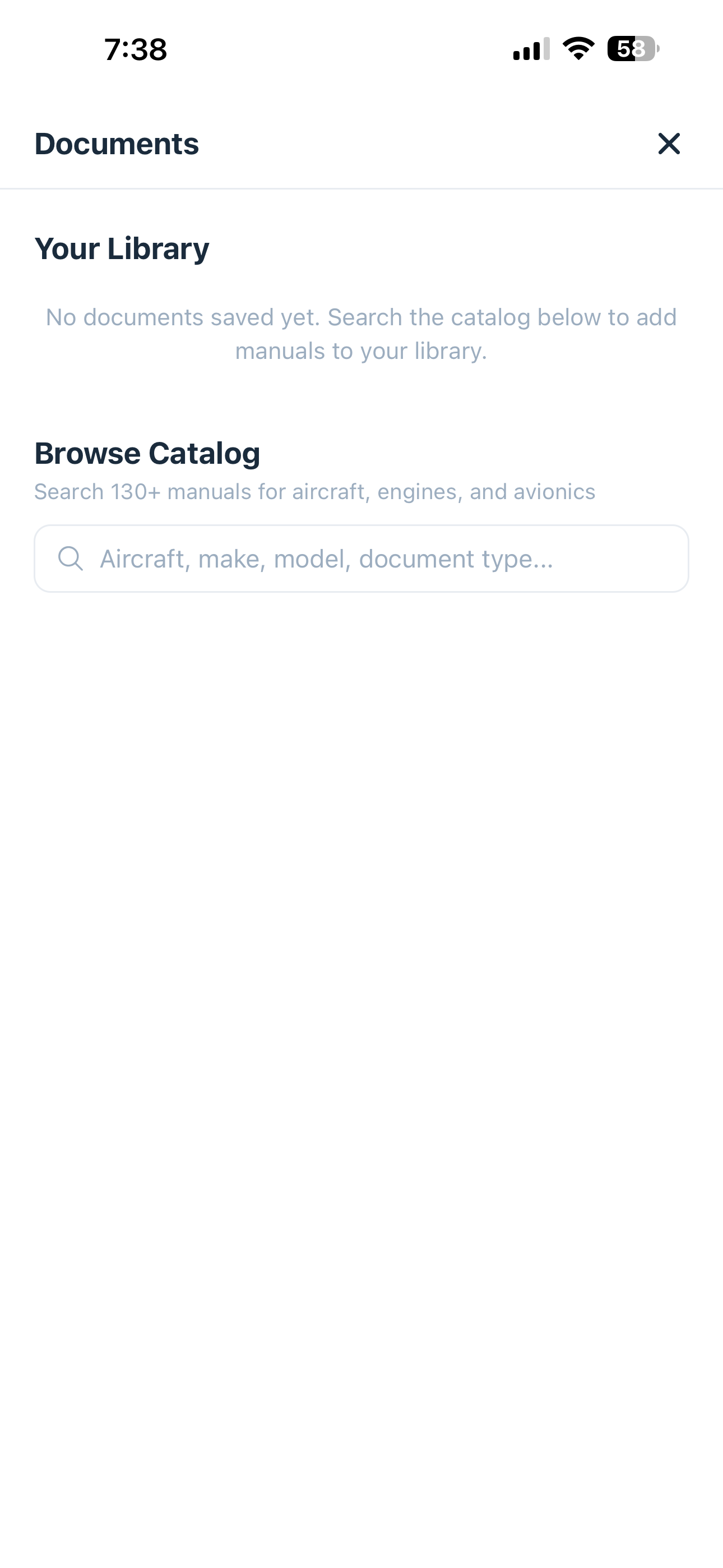
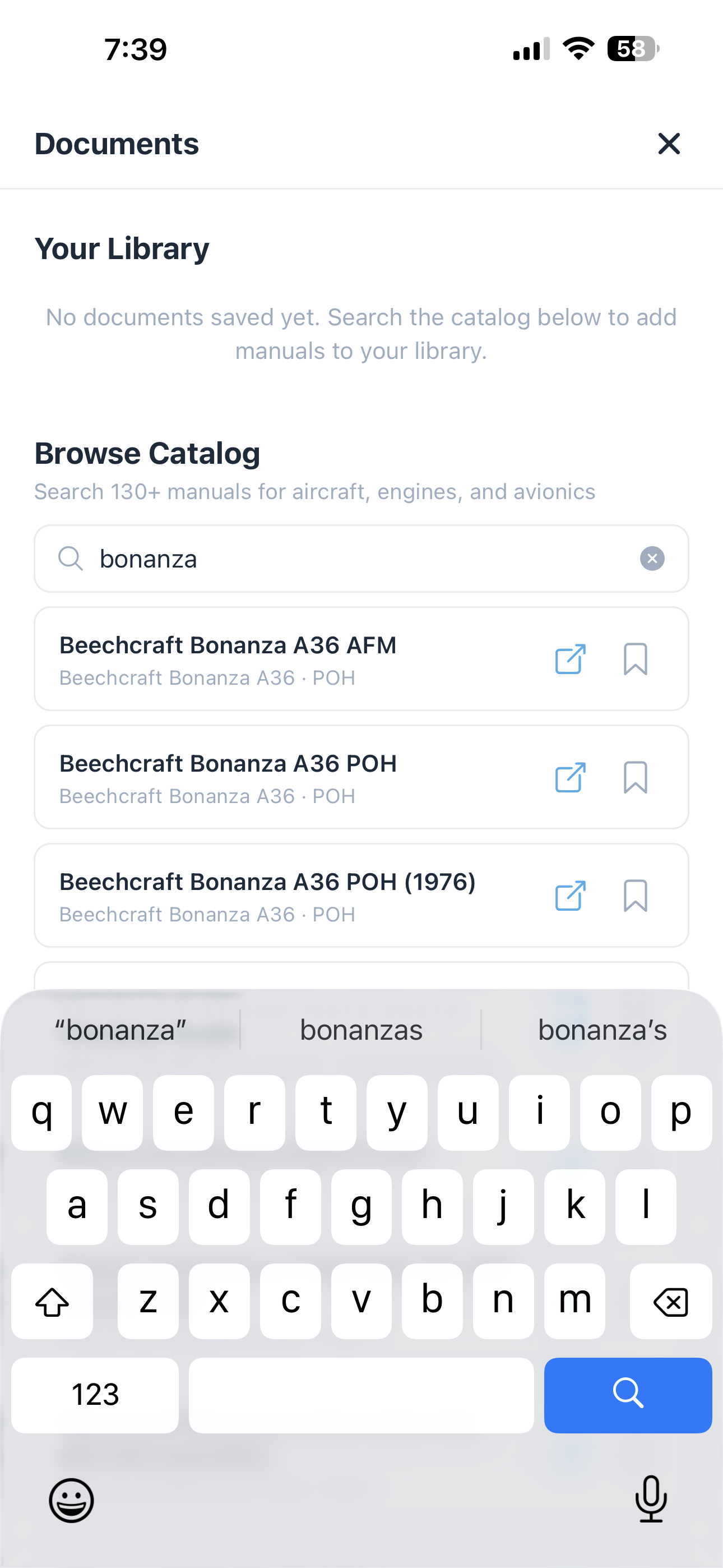
Searching Documents
Use the search bar at the top of the Documents Library to find content within manuals — POH sections, procedures, performance tables, etc. The search uses semantic indexing so you can ask “hot start procedure” and find the relevant POH section even if the manual uses different wording.
Asking AI About Your Aircraft
For procedural questions, the AI Assistant often beats document search. Ask “What’s the hot start procedure for my engine?” or “What’s the right power setting for 65% power at 9,000 ft at 2300 RPM?” and it pulls from the relevant manual page automatically.
Scanning Logbooks and Paperwork (Paid plans, Owners and Admins)
Your paper logbooks can live in 5-by-5, where everyone in the group can read them and the AI Assistant can search them.
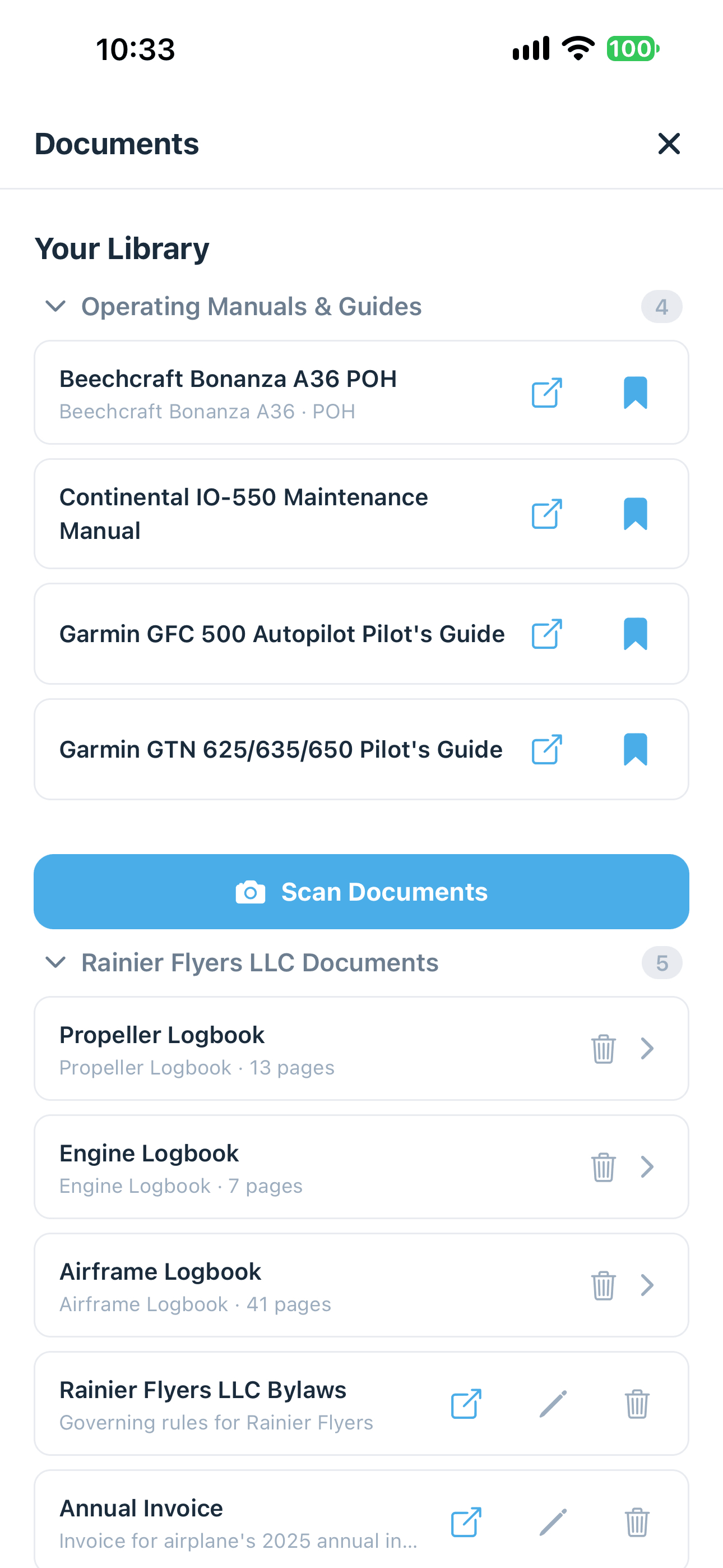
- Open Maintenance → Documents and tap Scan Documents.
- Choose the aircraft (if your group has more than one) and what kind of document it is: Airframe, Engine or Propeller Logbook, an Invoice, a Manual, or Other. For an engine logbook on a twin, pick which engine.
- If you’ve scanned this logbook before, choose Continue to add to it, or Start a new document. A real logbook grows over many sessions, so you don’t need to do it all at once. A new one gets a name, for example Engine Logbook 2008–2019.
- Tap Start Scanning. Your phone’s document scanner finds the page edges and squares each page up. Scan as many pages as you like, then tap Complete.
- Photographed a two-page spread in one shot? Before you finish, use Split page into two pages on that photo.
5-by-5 then reads each page in the background and turns it into searchable text. Pages usually take a minute or two.
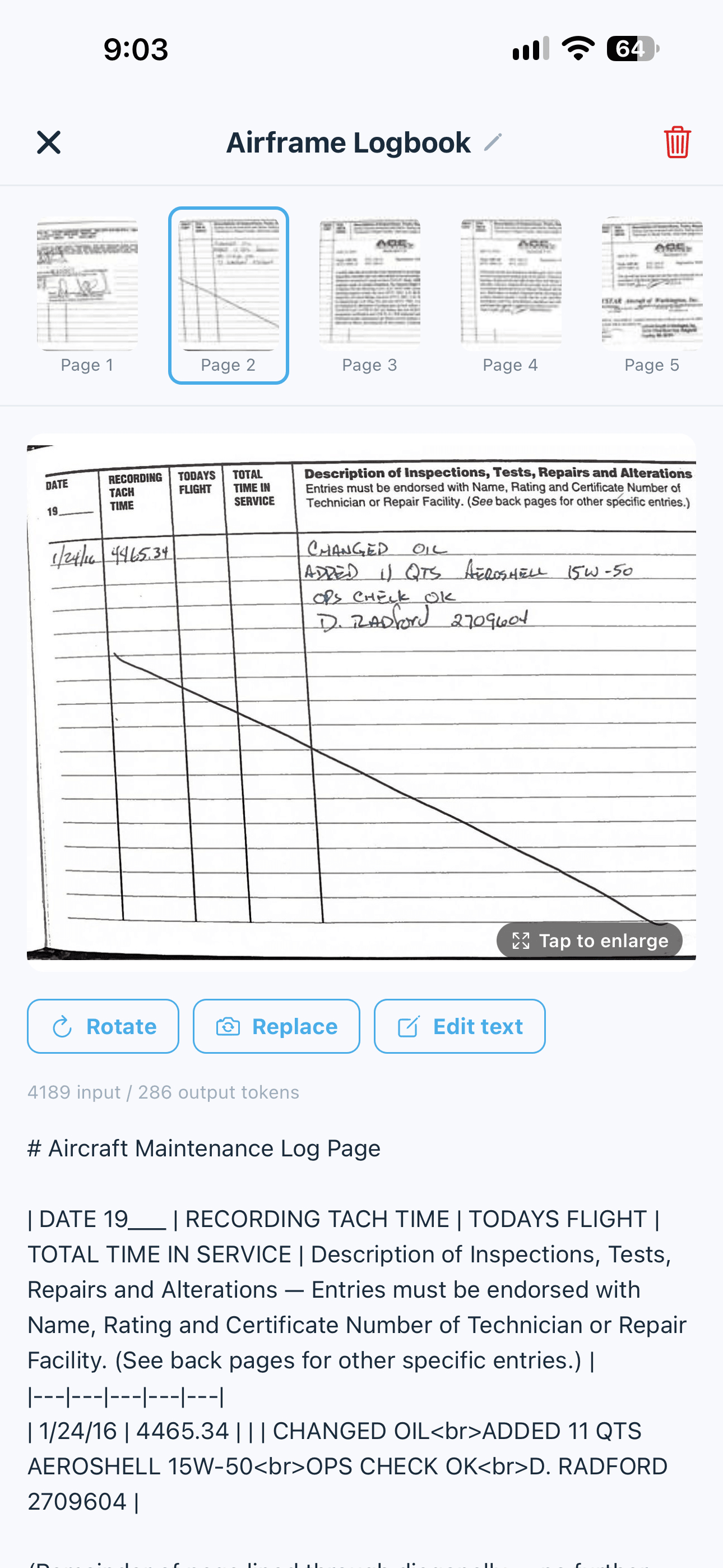
Tap a scanned document to open it. You can:
- Tap a page to enlarge it and zoom in on the handwriting
- Rotate a page that came out sideways
- Edit the transcript if a word was misread, so searches and Ask AI get it right
- Replace a page with a better photo, or Add pages before or after any page
- Rename the document, or delete a page (owners and admins only)
Scanning is part of the paid plans; a free trial includes 20 scanned pages, enough to see how well it reads your own logbooks. Your A&P mechanic, if you’ve invited one, can read the scanned logbooks but not your other documents.
Scheduled Maintenance Items
Planned maintenance items are tracked by calendar time, tach hours, or both, and 5-by-5 automatically calculates when each item is due.
Adding a Maintenance Item
- Tap the + button at the top right of the Maintenance screen
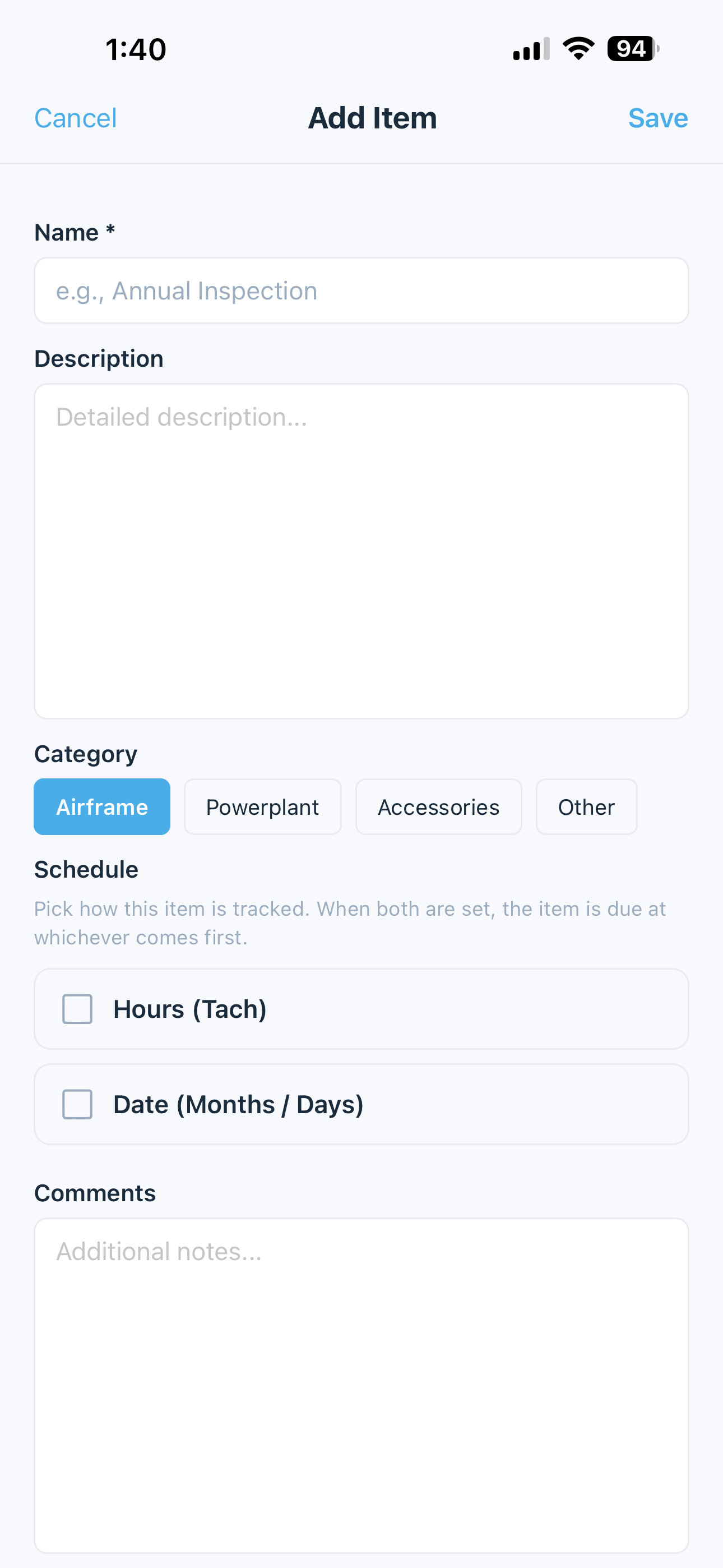
- Fill in:
- Name — what the item is (e.g., “Oil Change”, “Annual Inspection”)
- Description — any extra detail (e.g., AD/SB requirements, compliance notes)
- Category — Airframe, Powerplant, Accessories, or Other
- Triggers — select tach-based, calendar-based, or both. For each trigger, enter the interval and when the item is next due.
- Tap Save
Items are organized by category with collapsible sections — tap any category header to expand or collapse it. Each header shows the count of items in that category.
Tip: The free tier supports up to 5 maintenance items. Upgrade to a paid plan for unlimited items.
Due Date Calculations
5-by-5 calculates when each item is due based on its last completion:
- Calendar-based — due date = last completion date + interval (months or days)
- Tach-based — due tach = last completion tach + interval (hours)
Items are color-coded by status:
- Green — not yet due
- Orange — due within 10 hours or 10 days
- Red — overdue
Upcoming and overdue items also appear as alerts on the home screen.
Completing Maintenance
When a task is performed:
- Tap the item to expand it
- Tap Complete
- Enter the completion date and tach reading (if applicable)
- Add any notes — existing comments are shown so you can append to the history
- Tap Complete — 5-by-5 recalculates the next due date automatically
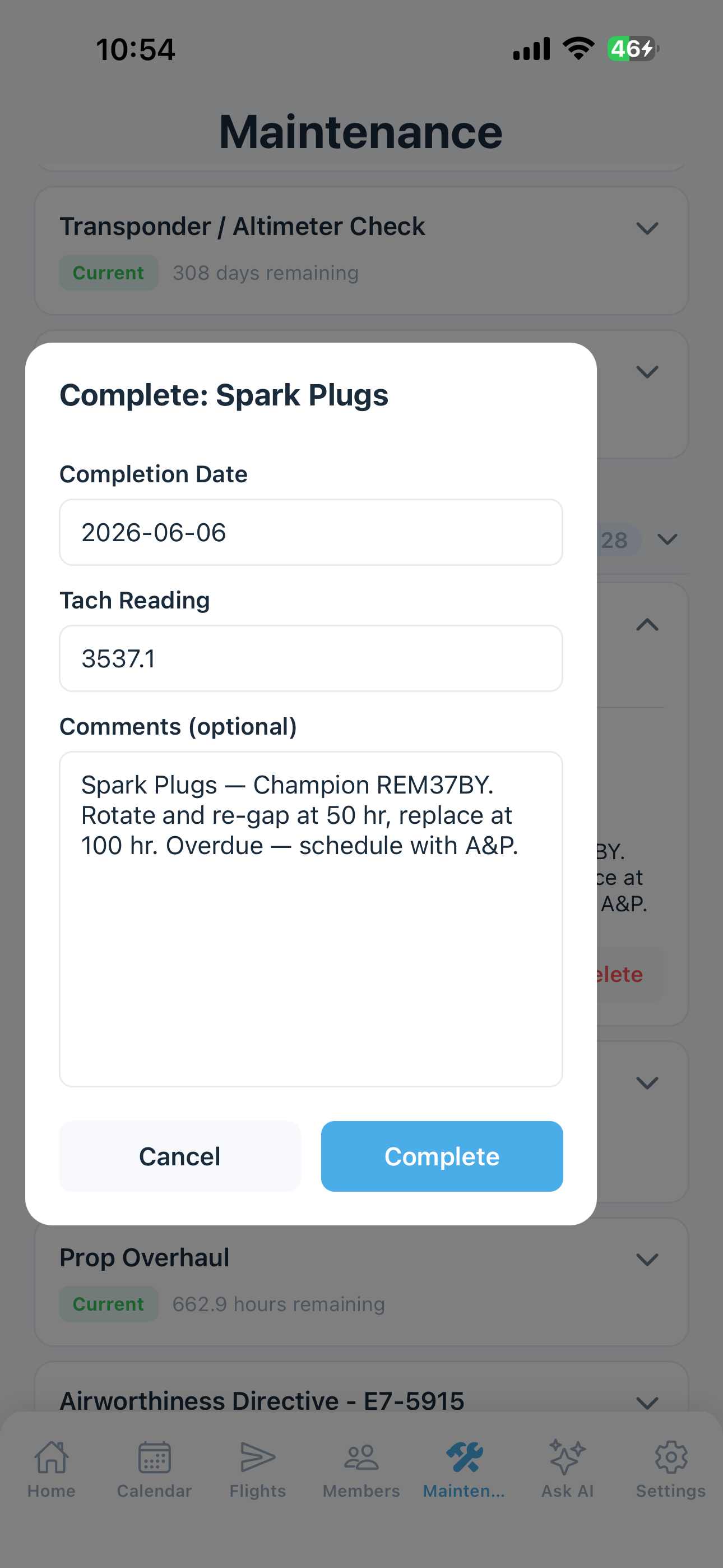
A completion history is saved for each item.
Viewing History
Each maintenance item keeps a record of completions. Tap View Completed at the top of the maintenance list to see past completion dates, tach readings, and notes for each item.
Marking an Item Not Applicable
Some maintenance items don’t apply to your specific aircraft, and the most common case is Airworthiness Directives. The automatic AD import pulls every AD published for your make, model, and engine — but most ADs are scoped to specific serial-number ranges, sub-models, or installed equipment, so a significant share won’t apply to your individual aircraft. Rather than ignore them on the active list (and have them noisily flag as overdue), use Mark as N/A to file them away cleanly. Other examples: a feature you don’t have, or an inspection only required in a different operating environment.
Long-press the item and select Mark as N/A to hide it without deleting it from your records. N/A items still appear in the completion history but don’t show on the active list or affect home-screen alerts.
Automatic AD Import (Paid plans)
5-by-5 can automatically pull Airworthiness Directives (ADs) from the FAA Federal Register based on your aircraft’s make, model, and engine type.
To fetch ADs:
- Go to Settings and confirm your aircraft Make, Model, and Engine are set using the dropdown menus
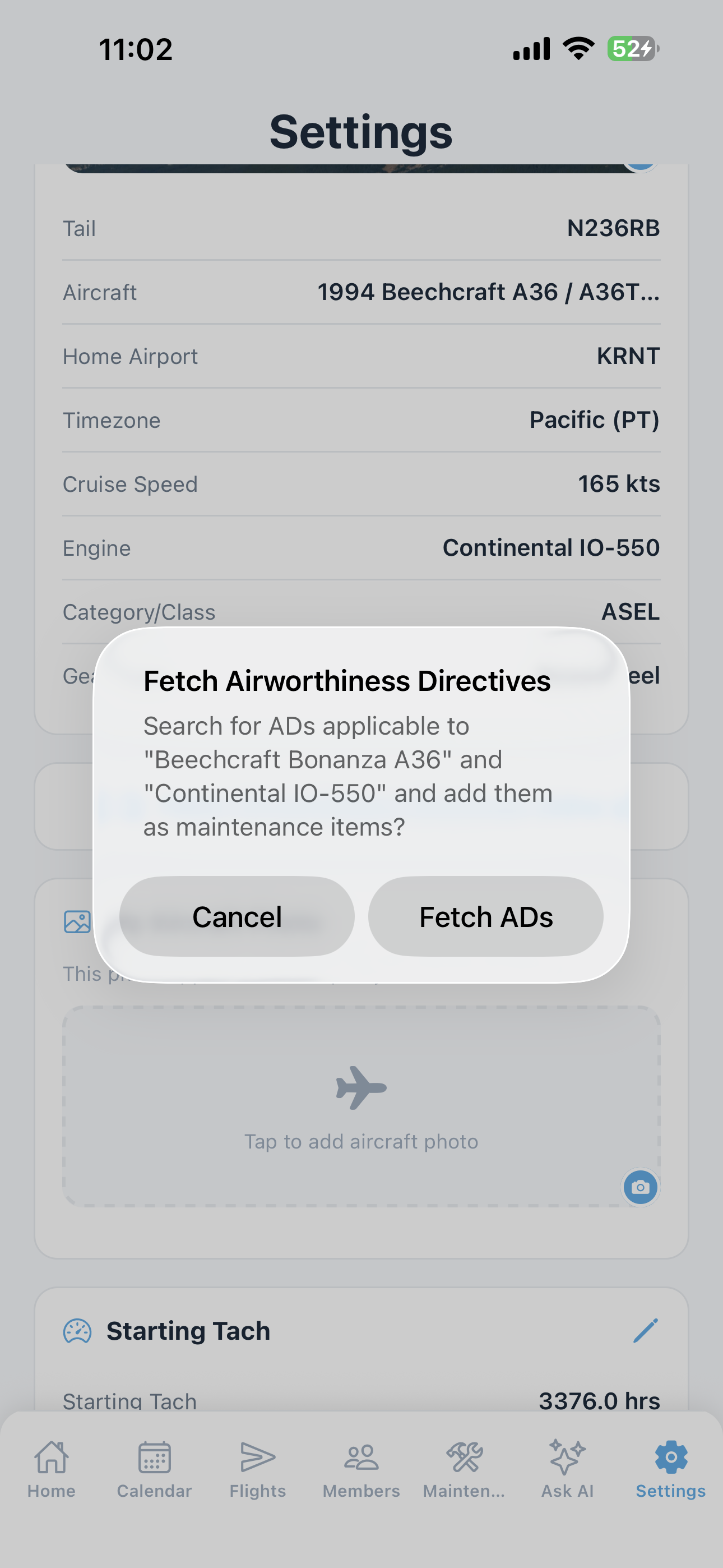
- Tap Fetch Airworthiness Directives (ADs) — located just below the Aircraft section in Settings
- 5-by-5 searches the Federal Register and shows how many applicable ADs were found
- Tap Fetch ADs to confirm — each AD is created as a maintenance item, auto-categorized as Airframe, Powerplant, or Accessories based on the directive content
ADs are named using the format “Airworthiness Directive — [document number]” with the full title and abstract in the description field. A link to the Federal Register entry is included in the comments.
Duplicate detection is built in — if you fetch ADs again later to check for new ones, only ADs that don’t already exist in your tracker are added.
Groups with more than one aircraft: ADs are fetched for one aircraft at a time — the one selected in the aircraft picker. The button reads Fetch ADs for and the tail number, and the ADs it finds are added to that aircraft’s maintenance list only. Select the next aircraft and fetch again for it. Two identical airframes in the same fleet each get their own copy of every AD.
Squawks
The bottom of the Maintenance screen shows all open squawks with their severity. Tap any squawk to view details, resolve it, or delete it. Use the + button to file a new standalone squawk (not tied to a specific flight).
Anyone can report a squawk. Owners, Admins, A&P Mechanics, and the Maintenance Officer can resolve one; whoever reported it, plus Owners and Admins, can edit or delete it. Resolving or deleting a squawk tells the whole group — see Squawk Reporting.
When a squawk is filed, everyone in the group is notified by email automatically — the maintenance roles, owners, and admins are addressed directly, every other member is CC’d. See Squawk Reporting > Email Notifications for the full routing.
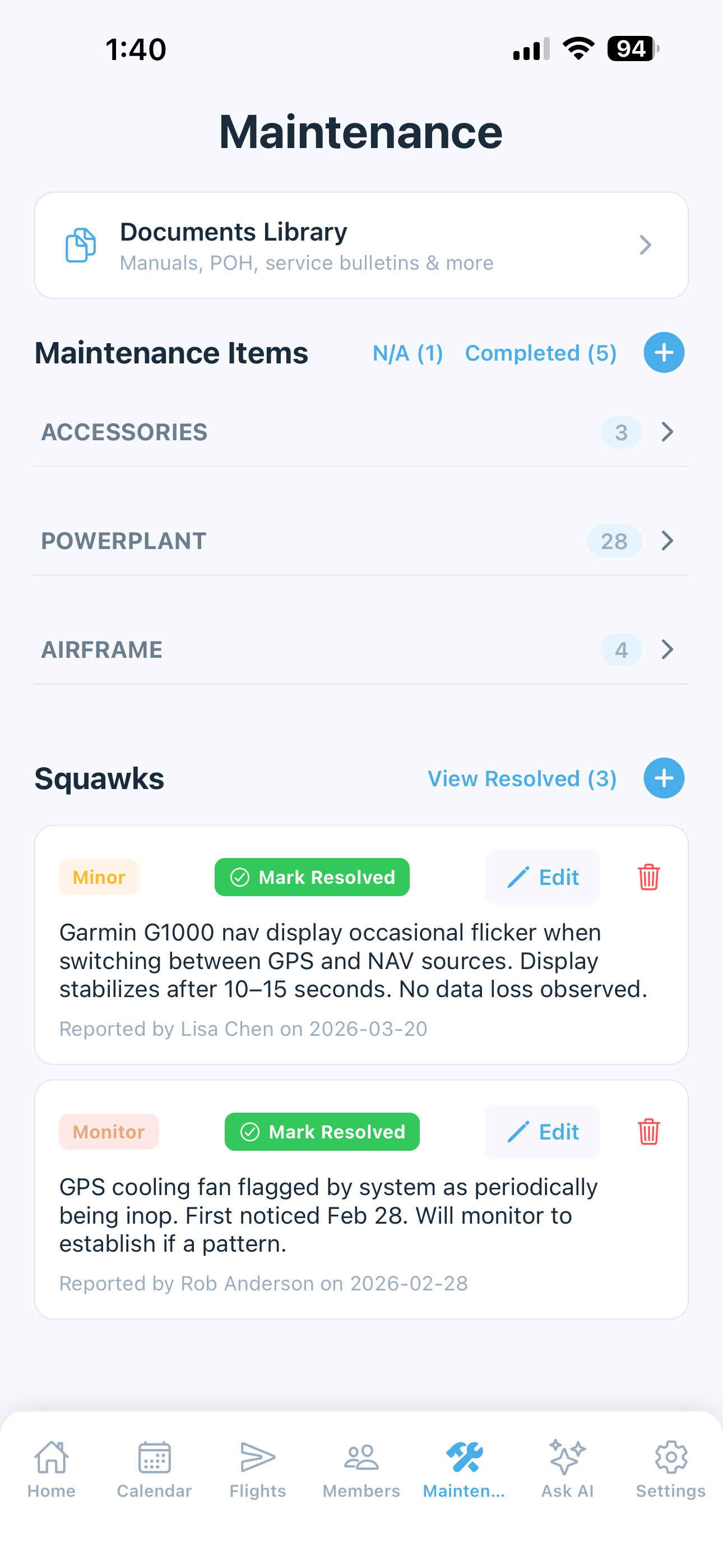
See Squawk Reporting for the full workflow.
Inviting Your A&P Mechanic (Paid plans)
On paid plans, you can give your A&P or IA mechanic limited access to your maintenance records — they can view items, mark them complete, read your scanned logbooks, and resolve squawks. They cannot see your other documents (invoices, bylaws, and anything else uploaded), flights, the ledger, or member contact information.
When invited, the mechanic also automatically receives squawk alert emails — so they hear about new discrepancies the same way you do, without you forwarding anything.
On a Solo account there’s no Members screen, so the invite lives here instead — an Add your A&P button sits directly under the Maintenance Items header.
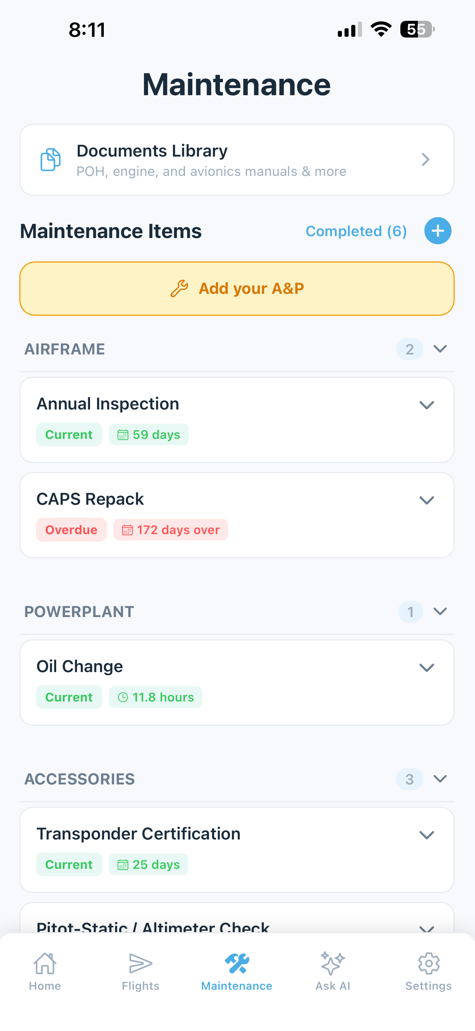
See Members & Roles > A&P Mechanic Access for the full setup.
Important: 5-by-5 maintenance tracking is for convenience only. It is not a substitute for the aircraft's official maintenance logbooks maintained by a certified mechanic or repair station.